
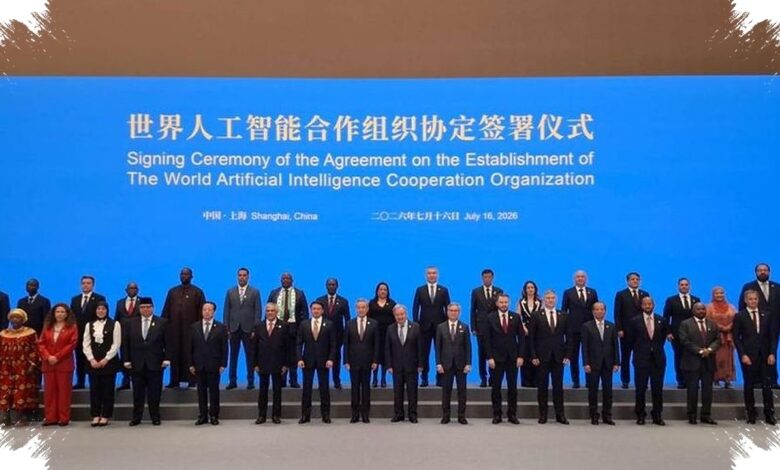
Indonesia has joined 28 other founding members of the World Artificial Intelligence Cooperation Organization, or WAICO, a China-backed intergovernmental body focused on international AI cooperation. The organization arrives as competition over chips, computing capacity and AI regulation becomes increasingly strategic.
WAICO’s central promise is that artificial intelligence should not be shaped by one country alone. Its creation places Indonesia in a new forum where governments may influence the rules intended to guide AI development and use across borders.
China introduced the organization in Shanghai during the 2026 World Artificial Intelligence Conference. UN Secretary-General Antonio Guterres attended the event, while WAICO was formally established on July 16 and is headquartered in Shanghai.
Chinese President Xi Jinping used the conference opening on Friday, July 17, to call for broader participation in AI development. His remarks were widely seen as an implied criticism of the United States amid the two countries’ intense technology rivalry.
“AI development should not become a solo stage for one country, but rather a symphony of international cooperation,” Xi said, according to Al Jazeera. He also called for opposition to the excessive use of national security concepts in the AI sector.
Why AI Governance Has Become Strategic
WAICO is intended to strengthen international collaboration in artificial intelligence and help develop AI regulations in different countries. The stated objective is to ensure that the technology remains safe and benefits humanity.
The policy debate extends well beyond consumer-facing digital services. AI is closely tied to semiconductor production, data centres, energy supply and advanced military systems, making it a major part of wider industrial and geopolitical competition.
China has made AI one of the pillars of its industrial policy, investing across the domestic ecosystem from chip production to consumer applications. That ambition directly intersects with its contest with the United States for leadership in chip-based technologies.
China still trails the US in access to the most advanced semiconductors. However, it holds an advantage in electricity supply for the large data centres needed to train and run AI models.
China currently produces twice as much electricity as the United States, according to the reported figures. That gap is expected to widen as the Chinese government continues aggressive investment in its national energy network.
The country also dominates production of rare minerals that are important for chip manufacturing. Abundant and relatively inexpensive power gives Beijing a significant asset as AI’s energy requirements continue to rise.
29 Founding Members
The founding group includes countries from Asia, Africa, Latin America, Europe and the Middle East. Indonesia joins several states often described as important Global South powers, including Brazil, Malaysia, South Africa, Russia and Pakistan.
| No. | WAICO Founding Member |
|---|---|
| 1 | China |
| 2 | Algeria |
| 3 | Belarus |
| 4 | Brazil |
| 5 | Cambodia |
| 6 | Cameroon |
| 7 | Congo |
| 8 | Cuba |
| 9 | Ethiopia |
| 10 | Indonesia |
| 11 | Kazakhstan |
| 12 | Kenya |
| 13 | Kyrgyzstan |
| 14 | Laos |
| 15 | Lesotho |
| 16 | Malaysia |
| 17 | Mozambique |
| 18 | Myanmar |
| 19 | Nicaragua |
| 20 | Oman |
| 21 | Pakistan |
| 22 | Russia |
| 23 | Senegal |
| 24 | Serbia |
| 25 | South Africa |
| 26 | Tajikistan |
| 27 | Uzbekistan |
| 28 | Venezuela |
| 29 | Zambia |
Some analysts expect Beijing to use WAICO as a political vehicle to shape AI policy discussions underway at the United Nations. For Indonesia and the other members, the organization now raises a central question: how shared AI rules can be formed while global technology competition continues to intensify.