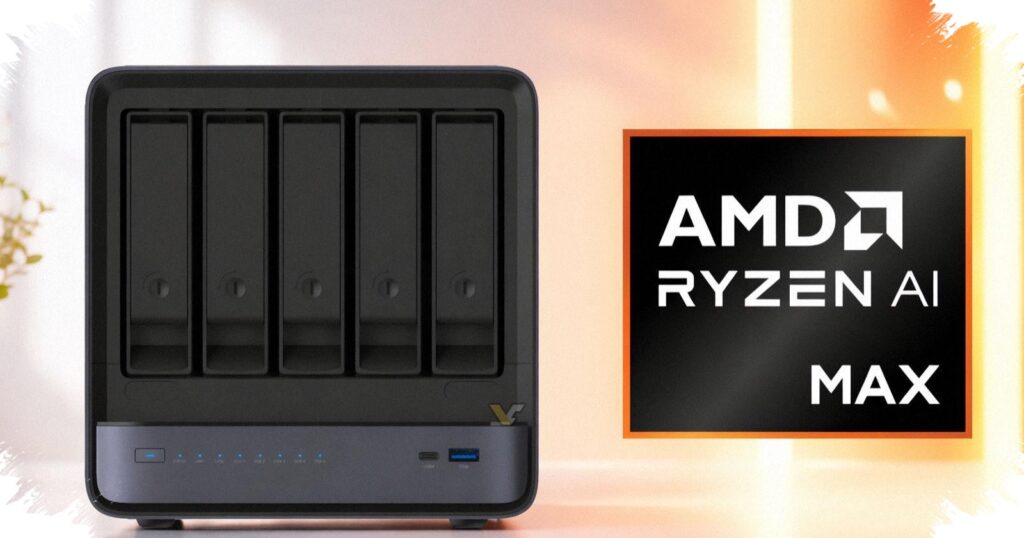
Minisforum’s N5 Max stands out immediately because it is not trying to be a conventional NAS. The device blends high-end storage hardware with Strix Halo computing muscle, turning what is usually a file server into something much closer to a premium mini PC built around serious workloads.
That unusual positioning also comes with an equally unusual price. Minisforum plans to begin sales on 23 April, with the N5 Max listed at $2,899, placing it far above the typical home NAS segment and squarely into enthusiast and professional territory.
A NAS built around Strix Halo
The center of the N5 Max is AMD Ryzen AI Max+ 395, paired with 64 GB of LPDDR5x memory. According to Notebookcheck, which cited Tom’s Hardware, that combination makes the device feel more like a high-performance computer than a storage appliance.
Minisforum is also shipping a barebone unit with only 128 GB installed, and that space occupies one of the five available NVMe slots. In practical terms, that means buyers should expect to budget for additional storage expansion if they want to take full advantage of the platform.
Storage capacity is the main attraction
The most eye-catching specification is the storage layout. Minisforum equips the N5 Max with five SATA bays and five NVMe slots, and the product material cited by Notebookcheck says the system can reach up to 200 TB in total capacity.
That figure puts the machine in a very different category from the average home NAS. It is better matched to professional users, content creators, or work environments that need large local storage with fast access speeds rather than just simple backup duties.
The design also shows that Minisforum is not treating the N5 Max as a basic network drive. The hardware suggests a broader focus on local computing tasks alongside storage, which is part of what makes the system unusual in this product class.
Connectivity aimed at demanding workflows
Minisforum did not hold back on I/O either. The N5 Max includes two 10 Gb/s Ethernet ports, two USB 4 ports rated at 80 Gb/s, one USB 4 port at 40 Gb/s, and HDMI 2.1 for display output.
That mix makes the device look less like a traditional NAS and more like a workstation-ready storage system. HDMI 2.1 in particular hints that the N5 Max is meant to do more than sit on a network and serve files.
Wireless connectivity is absent, which keeps the device’s purpose sharply defined. The focus stays on fast, stable wired connections, a choice that aligns with its target of high-volume transfers and heavy local storage use.
Why the memory choice matters
Notebookcheck notes that many Strix Halo systems usually arrive with 128 GB of RAM, but the N5 Max uses 64 GB instead. The outlet suggested that the lower capacity may simply reflect memory availability rather than a deliberate limitation of the platform.
Even so, 64 GB is still a strong figure for a NAS, especially one that is also expected to operate like a compact high-performance system. The memory configuration reinforces the idea that this product targets demanding users rather than routine home storage needs.
A niche product by design
At $2,899, the N5 Max is clearly not aimed at mainstream buyers. Its value proposition makes sense only for users who need powerful computation, fast networking, and very large storage capacity in one device.
For ordinary home use, features such as twin 10 Gb/s Ethernet ports or USB 4 at 80 Gb/s may be excessive. For data-heavy workloads, archived media libraries, or local processing tasks, however, the configuration offers a level of flexibility that standard NAS products rarely provide.
Notebookcheck described the N5 Max as one of the first NAS systems in the world powered by AMD Strix Halo. With sales set to begin on 23 April, Minisforum is pushing the boundary between NAS hardware and premium mini PC design even further.