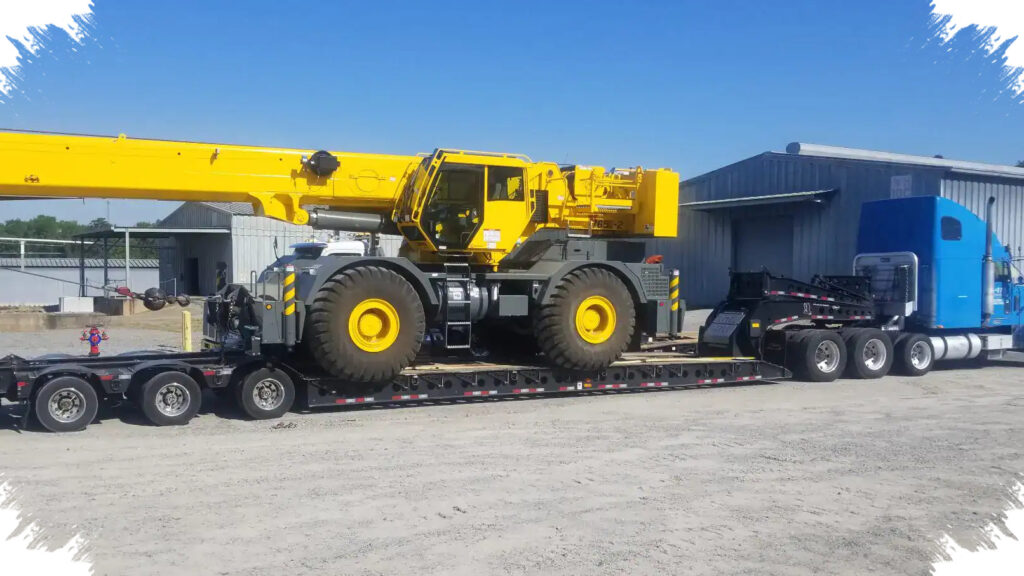
Moving oversized equipment is never just a matter of having a powerful engine. The cargo itself must stay low, stable, and protected while it travels across public roads, which is why lowboy trucks are used for jobs that ordinary trailers cannot handle safely.
Their role is closely tied to logistics and construction work, where excavators, bulldozers, cranes, industrial machines, and other large units need to be transported as complete equipment. Unlike vehicles used for towing damaged cars, a lowboy truck is meant to carry machinery that is ready for operation and needs to reach a project site in one piece.
Why the lower deck matters
The most important design feature of a lowboy truck is its deck height. Because the platform sits lower than a conventional trailer, tall cargo can pass under bridges, electrical lines, and other road obstacles with less risk.
That lower position also helps reduce the vehicle’s center of gravity. In practice, this gives the truck better stability when carrying heavy loads through curves or uneven roads, which is a major reason it is favored for large-scale transport.
Built for machines that cannot be divided
Lowboy trucks are chosen when equipment cannot be broken down into smaller components. Construction sites, mining operations, manufacturing facilities, and infrastructure projects often rely on this kind of transport because the units involved are simply too large and too heavy for standard hauling vehicles.
This is where the difference from a tow truck becomes clear. A tow truck is used to move a broken vehicle, while a lowboy truck is part of planned project logistics for moving operational heavy equipment between locations.
Loading becomes faster and safer
Another practical advantage is the loading process. Some lowboy models allow the trailer neck to be adjusted or removed, making it easier for heavy equipment to enter the deck without relying on extra lifting tools.
Systems such as ramps or a detachable gooseneck can speed up loading and unloading while also improving safety on site. For industries that must move units quickly, that efficiency matters as much as transport capacity.
Common lowboy truck types
Different lowboy configurations are used depending on the job. Each type offers a different balance of strength, stability, and loading flexibility.
Fixed Neck Lowboy
The neck is integrated with the deck, creating a solid and stable structure. However, loading usually requires an additional ramp.Fixed Gooseneck Lowboy (FGL)
The gooseneck is permanently attached and is commonly used for medium to long-distance transport. It is known for stable travel performance.- Removable Gooseneck Lowboy (RGN)
The neck can be removed, allowing the front of the deck to drop to the ground. This lets heavy equipment roll directly onto the trailer without extra assistance.
Matched with a strong tractor head
To work effectively, a lowboy truck is usually paired with a powerful tractor head. One example mentioned in the reference is the Isuzu GIGA Tractor Head, which is built for heavy transport needs with strong engine performance and good fuel efficiency.
The combination supports controlled distribution of heavy equipment across different road conditions, where stability and carrying strength remain essential. In large projects, delays in moving machinery can affect work flow, so the transport system must be reliable from loading to delivery.
Lowboy trucks continue to occupy an important place in heavy logistics because they combine load-carrying strength, road stability, and practical loading features in one transport solution designed for demanding work.