Smart home systems often fail in the simplest moments: a person sits still, a room remains occupied, and the lights switch off anyway. That mismatch has pushed presence sensing into the spotlight, especially as traditional PIR motion sensors continue to miss people who are not moving.
The newer answer comes from millimeter-wave presence sensors, which are designed to detect even subtle activity such as breathing. Unlike PIR units that depend on changes in body heat, these sensors use radar-based detection and are increasingly seen as the more reliable way to keep lighting, air conditioning, and automation scenes active when a room is still occupied.
Why presence sensing is gaining ground
The key difference is not just sensitivity, but the type of signal being read. PIR sensors look for heat changes caused by movement, while millimeter-wave models operate on radar frequencies such as 5.8 GHz, 24 GHz, and 60 GHz.
That frequency choice affects range, resolution, and whether a signal can pass through walls. It also shapes how much the sensor can do beyond basic motion detection, since more advanced chipsets can support multi-zone detection, fall detection, and even posture recognition.
In everyday use, the main issue is not whether a room is busy, but whether the system understands that someone is still there. That problem shows up often in home offices, bedrooms, and lounge areas where occupants may remain nearly motionless for long periods.
Where PIR still makes sense
Not every space needs the same level of sensing. Hallways and staircases can still work well with standard PIR sensors because those areas mainly depend on short bursts of movement rather than static presence.
Bathrooms, however, raise different requirements. Water resistance becomes important there, and Meeros MS605 stands out in that category with three detection zones, IP67 certification, and long battery life.
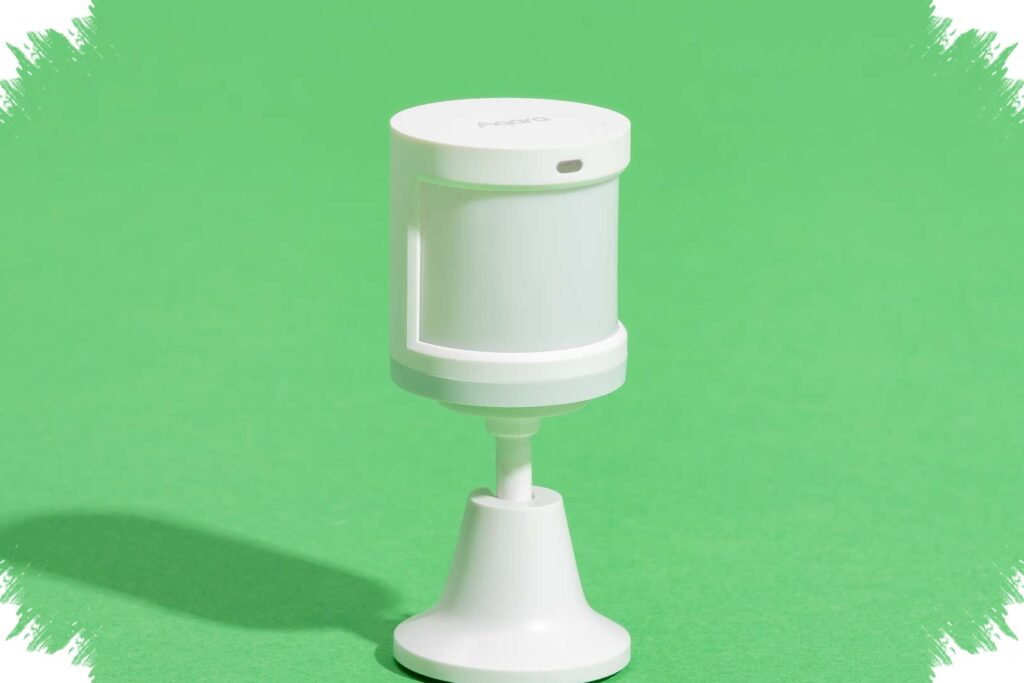
For a home office, the priority shifts again. Detecting a person who is sitting still matters more than spotting brief movement, which is why Aqara FP300 and Meeros MS605 are described as suitable options for that kind of room.
Higher-end sensing for more complex spaces
Open areas with more activity need a different approach. Aqara FP2 and the upcoming FP400 are more relevant in those settings because they offer better zone control and stronger support for tracking multiple people.
That extra capability matters when one room serves several purposes at once. In those cases, the sensor has to do more than turn a light on and off; it needs to understand where people are and whether they are still present.
Budget and midrange choices already on the market
In the more affordable segment, Lefair LWR01 stands out for broad compatibility across platforms. Even so, it is noted to be somewhat vulnerable to false positives at times.
SwitchBot Presence Sensor also fits the budget-minded category. It combines 60 GHz radar with PIR to improve detection, although Matter support requires a hub.
In the midrange, Meeros MS600 takes a wired approach and offers wider coverage. The trade-off is placement flexibility, which is not as easy as with battery-powered models.
Aqara FP300 sits in the same general tier and adds environmental sensing. Some of its advanced functions depend on Zigbee mode and a hub, so users need to match it to the ecosystem they already use.
Compatibility can matter more than the spec sheet
Price and features alone do not decide the best choice. Platform compatibility is often the bigger factor because some functions change depending on the protocol in use.
Matter, when running on Thread, brings better interoperability and reduces reliance on a single vendor. Still, not every advanced feature is always available in Matter mode.
Zigbee often unlocks more of the sensor’s full capability, but it usually means adding a hub such as Aqara Hub M2. Thread-based devices also need a Thread border router to join the smart home network.
Examples mentioned include IKEA Dirigera and Apple HomePod Mini, although these typically provide network support rather than full device control. That is why vendor apps are still commonly needed for initial setup and advanced configuration.
Where the category is heading next
The presence sensor segment is still evolving. Lefair LWR02 is said to be adding environmental sensing, while Aqara Thermostat Hub W200 points toward a blend of presence detection and smart climate control.
Aqara FP400 is also being positioned for larger rooms. It is described as bringing Thread support, posture detection, and fewer false positives compared with earlier approaches.
Even with those improvements, the practical challenge remains the same. Sensitivity still has to be tuned carefully, because pets, fans, and moving air can still trigger false positives in certain conditions.
Source: www.geeky-gadgets.com