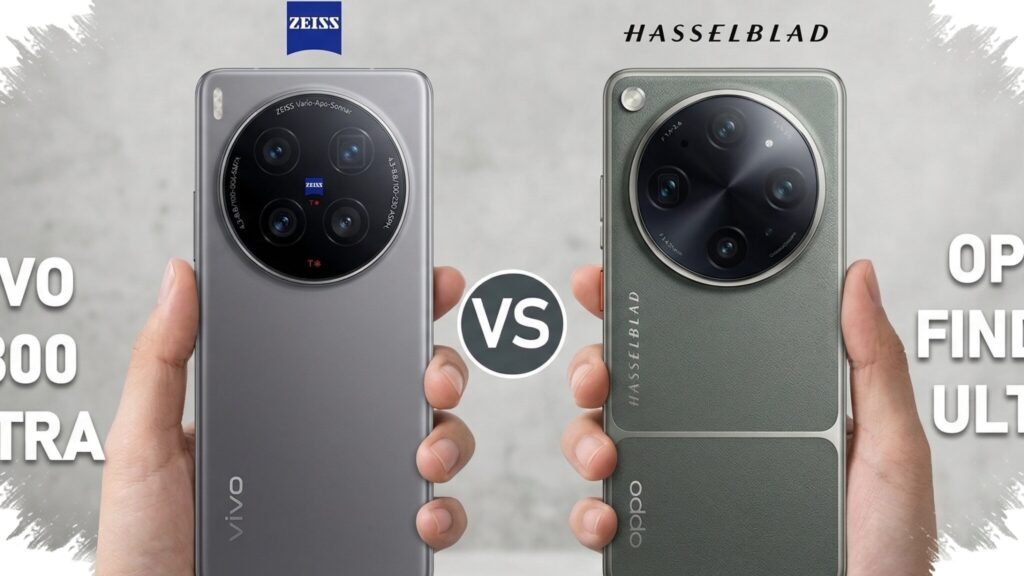
Two ultra-premium phones are chasing the same audience, but they do not lean on the same strengths. vivo X300 Ultra and OPPO Find X9 Ultra are both built for users who care about photography, battery life, and raw performance, yet the balance between those priorities is different.
That difference matters because the hardware margins are extremely tight. On paper, both devices look almost identical in several core areas, but battery capacity, telephoto strategy, and body design create the clearest separation.
Display and performance stay nearly even
Both phones use a 6.82-inch LTPO AMOLED panel with a 144Hz refresh rate. They also share an ultrasonic in-display fingerprint scanner and an estimated screen-to-body ratio of around 90 percent.
The protection and brightness figures are where the screens part ways. vivo uses Armor glass, while OPPO relies on Gorilla Glass Victus 2 and lists 800 nits typical brightness, 1800 nits HBM, and 3600 nits peak brightness.
The performance race is just as close. Both run Snapdragon 8 Elite Gen 5 on a 3 nm process, and their AnTuTu v11 scores sit very close together, with vivo X300 Ultra at 4,085,695 and OPPO Find X9 Ultra at 4,110,112.
Memory options are identical as well. Each model is available in 12/256GB, 12/512GB, 16/512GB, and 16GB/1TB configurations.
The camera fight is where the real separation starts
Both smartphones use a 200MP main camera, but the implementation is not the same. vivo X300 Ultra uses a SONY LYT-901 sensor sized at 1/1.12-inch with gimbal OIS, while OPPO Find X9 Ultra also uses a SONY LYT-901 sensor at 1/1.12-inch with OIS.
The biggest contrast comes from the telephoto setup. vivo opts for a 200MP periscope telephoto with an ISOCELL HP0 sensor measuring 1/1.4-inch and offering 3.7x optical zoom, equal to 85 mm.
OPPO takes a different route with two periscope telephoto cameras. Its primary telephoto is a 200MP unit using an OmniVision OV52A 1/1.28-inch sensor with 3x optical zoom, equal to 70 mm, and it is paired with an additional 50MP telephoto camera that reaches 10x optical zoom.
For wider shots and selfies, the two devices are still aligned. Both include a 50MP ultrawide camera and a 50MP front camera, which keeps the overall setup strong for everyday shooting and creative content.
Design choices give each model a different character
The rear camera module is one of the few visual elements they clearly share, but the rest of the styling takes them in different directions. OPPO Find X9 Ultra adopts a Scandinavian Design inspired by the Hasselblad X2D 100C Earth Explorer Edition, complete with a synthetic leather back, black finish, and an orange shutter button.
vivo X300 Ultra goes for a simpler look. It comes in black, green, and white, with the green and white variants offering two different gradient finishes.
Thickness is another visible distinction. vivo X300 Ultra is the slimmer device, measuring around 8.2 to 8.5 mm, while OPPO Find X9 Ultra sits in the 8.7 to 9.1 mm range.
Battery life may decide the winner for many buyers
OPPO has the stronger battery spec on paper, thanks to a 7050 mAh Si/C Li-Ion battery. vivo X300 Ultra comes with 6600 mAh for the international version and 6400 mAh for the European version.
Real-world endurance testing also favors OPPO. GSMArena recorded 20 hours and 10 minutes of active use for Find X9 Ultra, while vivo X300 Ultra reached 15 hours and 45 minutes.
Charging speed is similar, though. Both support 100W wired charging and can fully charge in roughly 45 to 46 minutes with the bundled charger.
The extra charging features differ slightly. vivo includes 40W wireless charging plus reverse wired and reverse wireless charging, while OPPO offers 50W wireless charging, reverse wired charging, and reverse wireless charging at 10W.
In the end, the comparison comes down to priorities rather than a clear mismatch. OPPO Find X9 Ultra has the advantage in battery capacity and a more flexible telephoto system, while vivo X300 Ultra counters with a slimmer body, a strong main camera setup, and fast charging features that keep it firmly in the same premium tier.
Source: www.idntimes.com