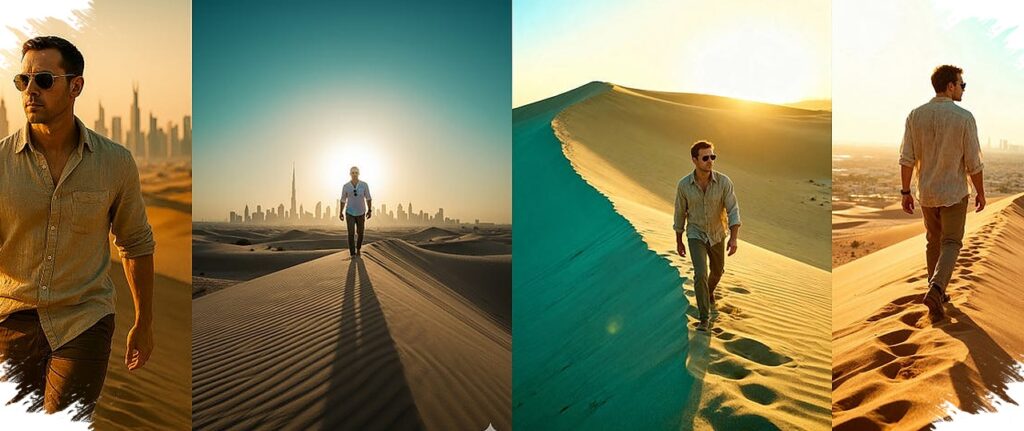
Travel photos from Jordan are increasingly being shaped with Gemini AI to look cinematic without losing a sense of realism. The appeal lies in prompts that keep facial details natural while adding warm light, emotion, and the feeling of an actual journey.
That approach works especially well in Jordan, where the visual backdrop is already strong. Petra, Wadi Rum, the Dead Sea, Amman, traditional markets, desert camps, and Jerash each offer a different atmosphere, from red stone and open sand to sunset tones and dramatic night scenes.
Why Jordan stands out for AI travel images
Jordan combines ancient history, wide desert landscapes, and the distinctive red stone of the Middle East. Those elements make travel images feel more alive when they are paired with natural lighting and relaxed poses.
The color of the sand, the old architecture, and the broad evening sky often create a film-like result. For that reason, many users look for prompts that do more than change the background.
They want expressions, skin texture, and clothing details to stay natural as well. Gemini AI has become popular in this area because it is seen as capable of preserving facial detail well.
Prompts designed to feel like real trip moments
One prompt places the scene in Petra during the afternoon. It focuses on golden sunlight hitting massive red rock walls, while the user walks casually, turns toward the camera, and wears clothing that appears to move with the desert wind.
Another prompt shifts to Amman at night. The user sits on a rooftop cafe, holds a cup of coffee, and looks slightly away from the camera, with warm city lights and natural bokeh in the background.
A third prompt moves to Wadi Rum at sunrise. The user stands on desert sand and holds a scarf that catches the wind, while the soft orange morning sky lights one side of the face naturally.
The Dead Sea becomes the setting for a daytime image in the fourth prompt. The composition shows calm blue water, realistic sunlight reflections, and a relaxed pose at the water’s edge with a comfortable expression.
Market, camp, and ancient street settings
The fifth prompt uses a Jordanian traditional market at night. Warm Middle Eastern hanging lights, a controlled sense of activity, and a user walking past spice shops with a look of wonder help build the mood.
The sixth prompt turns to a desert camp under a sky full of stars. The user sits near a small campfire and looks at the camera, while firelight softly touches the face and the tent details remain sharp and cinematic.
The seventh prompt ends in Jerash on a road that feels ancient as evening approaches. The user walks slowly while holding a hat, surrounded by grand Roman architecture, warm sunset light, and clear stone textures underfoot.
These seven prompts share the same goal: results that still feel authentic. They are built around natural light, relaxed body language, and expressions that keep the image tied to a real travel moment.
Why this style keeps growing in demand
Travel photo editing is moving beyond attractive backgrounds alone. Users now want images that also carry mood, whether the feeling is dramatic, elegant, or rooted in modern adventure.
That is why details such as soft shadows, sand texture, sunset skies, firelight reflections, and warm night lighting matter so much. In Jordan, those elements help an AI travel photo look more polished without erasing the user’s identity.
Source: radartasik.id