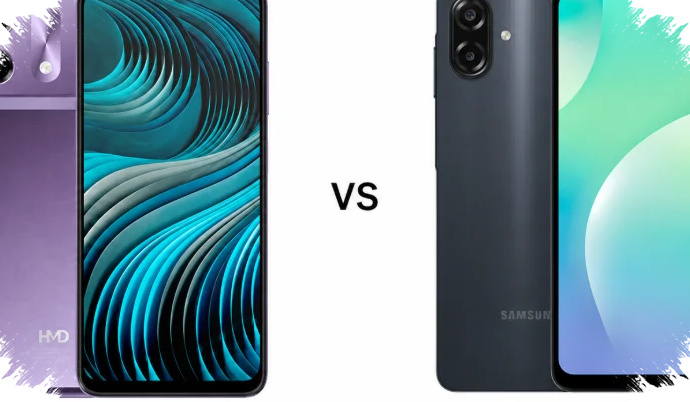
For buyers who want the lowest possible entry price, the Samsung Galaxy M07 makes a strong case before the spec sheet even matters. It sits around ₹7,500, while the HMD Vibe 2 is positioned near ₹11,000, and that gap alone changes how each phone should be judged.
The two devices are aimed at different priorities. HMD leans on a smoother display and a larger battery, while Samsung focuses on a more practical balance of price, software support, and day-to-day usability.
Display and feel in hand
HMD Vibe 2 is the more eye-catching option on paper because it uses a 6.75-inch IPS LCD with a 120Hz refresh rate. That should make scrolling through apps and playing games feel noticeably smoother.
Samsung Galaxy M07 counters with a 6.7-inch PLS LCD running at 90Hz and a 720 x 1600 resolution. The sharpness is broadly similar between the two, but Samsung is the more restrained choice for casual daily use.
The physical design reflects that difference in priorities. HMD Vibe 2 uses a plastic body and feels thicker because of its larger battery, while Galaxy M07 is slimmer and looks more modern, with IP54 protection against splashes.
Performance and storage priorities
Samsung equips the Galaxy M07 with the MediaTek Helio G99, 4GB of RAM, and 64GB of storage. It also supports 25W charging, and Samsung promises six major Android upgrades starting from Android 15.
HMD Vibe 2 runs on the Unisoc T8200 and comes with up to 6GB of RAM and 128GB of storage. That gives it more room for apps, files, and other content, which may matter more to users who store a lot on the device.
The operating system also differs. HMD Vibe 2 launches with Android 16, so it arrives with the newer software version out of the box. Samsung’s advantage is the longer and clearer update promise, which is rare in this segment.
Battery and charging trade-off
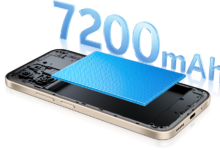
Battery capacity is one of HMD Vibe 2’s biggest selling points. Its 6000mAh cell is more appealing for streaming, gaming, and long days away from a charger.
Galaxy M07 uses a smaller 5000mAh battery, but it supports 25W fast charging. That makes recharging easier and quicker than the HMD phone, which is limited to 18W.
Camera differences are more than the numbers suggest
Both phones feature a 50MP main rear camera and an 8MP front camera. Even so, Galaxy M07 has the edge thanks to PDAF on the rear camera and stronger image processing.
In daylight shots, Samsung is described as producing more balanced color and dynamic range. It also keeps enough detail for social media without pushing the image too far.
HMD Vibe 2 can still deliver acceptable photos in bright conditions. But its color consistency and secondary camera quality are simpler, and that becomes more noticeable when the light is not ideal.
Low-light results remain limited on both phones, which is expected at this price. Even so, Galaxy M07 is said to handle shadows and highlights with a little more discipline, including selfies with more balanced skin tones.
Small details that matter in daily use
Both phones keep the 3.5mm headphone jack, which remains useful for budget buyers. Samsung also offers a dedicated microSD slot, while HMD Vibe 2 is only noted as supporting microSD.
Connectivity gives Samsung another slight edge. Galaxy M07 includes Bluetooth 5.3, while HMD Vibe 2 uses Bluetooth 5.0.
That leaves the two phones with very clear identities. HMD Vibe 2 is the more tempting choice for people who want a 120Hz screen, a larger battery, and more memory headroom, but Galaxy M07 looks like the safer pick for most buyers because it is cheaper, more balanced, and backed by stronger software support.
Source: www.gizmochina.com