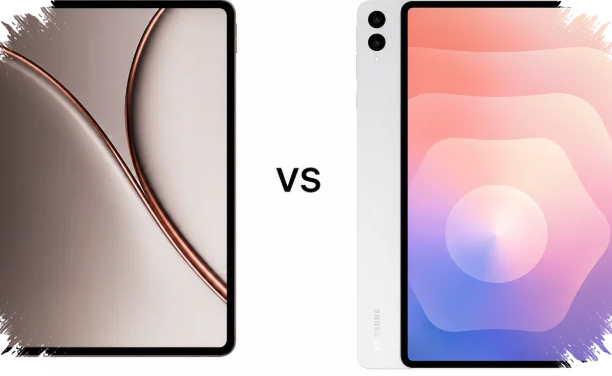
The most striking thing about this tablet matchup is not just the specifications, but the price gap that separates them. OnePlus Pad 4 sits at around $700 or ₹60,000, while Galaxy Tab S11 Ultra is positioned near $1,200 or ₹111,000, making Samsung’s model almost twice as expensive.
That difference instantly changes how the two devices are perceived. OnePlus looks like the aggressive value option, while Samsung presents a more expensive package that tries to justify its premium through a fuller feature set.
Performance First for OnePlus
For buyers focused on raw speed, OnePlus Pad 4 makes a strong case. It runs on Snapdragon 8 Elite Gen 5, which is described as one of the most powerful mobile processors available right now.
OnePlus pairs that chipset with UFS 4.1 storage and a 144Hz display. The result is a tablet that should feel fast in everyday use and built for smooth navigation.
Samsung does not arrive with weak hardware either. Galaxy Tab S11 Ultra uses Dimensity 9400+, which still places it firmly in the high-end category for gaming, editing, and multitasking.
Where Samsung Spends More of the Budget
Samsung’s pricing becomes easier to understand when the broader feature list comes into view. Galaxy Tab S11 Ultra runs One UI 8.5 with Wireless DeX, turning the tablet into something closer to a desktop-style device for users who rely on multitasking.
The memory and storage options are also wider. Samsung offers 12GB to 16GB of RAM and storage from 128GB up to 1TB, plus microSDXC support for extra flexibility.
OnePlus Pad 4 is still well equipped with 8GB or 12GB of RAM and 256GB or 512GB of storage. The downside is that it does not provide expandable storage, which limits flexibility for users handling larger files.
Connectivity Clearly Favors Samsung
On connectivity, Galaxy Tab S11 Ultra is the more complete device. It supports Nano-SIM, eSIM, GPS, GLONASS, GALILEO, and BDS, making it the stronger choice for users who want more location and mobile connectivity options.
OnePlus Pad 4 does not include GPS and does not offer cellular connectivity. That makes it a more straightforward Wi-Fi-focused tablet in comparison.
Display Quality vs Display Speed
The two tablets also split their strengths on the screen. OnePlus Pad 4 uses a 13.2-inch IPS LCD with a 2400 x 3392 resolution, 144Hz refresh rate, Dolby Vision, and up to 1000 nits brightness in HBM mode.
Galaxy Tab S11 Ultra answers with a larger 14.6-inch Dynamic AMOLED 2X panel. It supports HDR10+ and reaches a peak brightness of 1600 nits, which gives it richer colors and deeper blacks than the IPS LCD panel on the OnePlus.
Samsung’s display only refreshes at 120Hz, but the AMOLED technology still gives it a more premium visual impression. For entertainment-focused buyers, that difference alone can help explain the higher price.
Design, Durability, and Build
Both tablets use aluminum for the frame and back. OnePlus Pad 4 measures 5.9 mm thick and weighs 672 grams, which keeps it relatively slim for a device with such a large battery.
Samsung adds a stronger durability angle with IP68 protection and Enhanced Armor Aluminum. That gives Galaxy Tab S11 Ultra a more rugged profile for outdoor use and tougher work environments.
Battery and Charging Shift the Value Debate Again
Battery life is another area where OnePlus pushes hard. OnePlus Pad 4 carries a 13,380mAh battery, which is among the largest in the premium tablet segment and especially appealing for long streaming, gaming, or work sessions.
Galaxy Tab S11 Ultra uses an 11,600mAh battery. It is still large, but the bigger AMOLED screen may also draw more power during heavy use.
Charging is where OnePlus has a clear edge. It supports 80W wired charging, while Samsung is limited to 45W, so the OnePlus tablet should return to full power more quickly.
Cameras, Sound, and Accessories
Samsung offers the more versatile camera setup. Galaxy Tab S11 Ultra includes a 13MP rear camera and an 8MP ultrawide camera, along with a 12MP ultrawide front camera that is better suited to video calls with multiple participants.
OnePlus Pad 4 keeps things simpler with a single 13MP rear camera and an 8MP front camera. Both tablets support 4K video recording at 30fps, but Samsung’s arrangement is clearly more complete for document use and calling.
Audio is one of the surprises in OnePlus’ favor. OnePlus Pad 4 includes eight speakers, while Galaxy Tab S11 Ultra has four stereo speakers.
Both tablets support stylus input for note-taking and creative work. Samsung still holds the advantage in accessory support and ecosystem integration, which matters for users already invested in its devices.
In the end, the choice depends heavily on what matters most. Galaxy Tab S11 Ultra justifies its higher cost with AMOLED display quality, Wireless DeX, microSD support, IP68 protection, GPS, cellular connectivity, and a broader feature set.
OnePlus Pad 4, meanwhile, makes a compelling case by combining top-tier performance, a bigger battery, faster charging, more speakers, and a far lower price. That is why the gap between them feels so wide, and why the more affordable tablet can look unusually complete for the money.
Source: www.gizmochina.com