For buyers looking at Ray-Ban Meta Glasses, the biggest decision is not whether the second generation is better. It is whether the improvements are large enough to justify the jump in price.
On paper, Gen 2 delivers the upgrades that matter most in daily use. It lasts longer on a charge and records better video, but Gen 1 still covers the core experience well enough that replacing it is not an obvious move.
The upgrade gap starts with price
The price difference is hard to ignore. Ray-Ban Meta Glasses Gen 1 currently starts at 224 USD and goes up to 284 USD, while Gen 2 sits between 379 USD and 499 USD depending on frame style and lens options such as transition or polarized.
That gap becomes more notable because both generations share the same Qualcomm Snapdragon AR1 Gen 1 processor. The newer model is not a new platform shift, but a refinement focused on specific improvements.
Battery life is the clearest practical gain
The strongest case for Gen 2 is battery endurance. Under moderate use, Gen 1 is rated for about 4 hours, while Gen 2 is rated for about 8 hours.
For a device meant to be worn outside and used throughout the day, that difference can change the experience. Gen 1 may run out in the middle of a longer session, while Gen 2 offers much more breathing room.
The charging case also improves. Gen 1’s case provides around 32 hours of extra power, while Gen 2’s case extends that to about 48 hours.
Even so, real-world battery life still depends on how the glasses are used. High music volume, frequent camera use, and AI features can drain power faster than the quoted figures suggest.
Video is where Gen 2 separates itself
Both generations use a 12 MP ultra-wide camera, but Gen 2 is said to have an improved sensor, and that difference shows up most clearly in video capture.
Gen 1 records video at 1440×1920 pixels at 30 fps. Gen 2 supports 1080p at 30 or 60 fps, and up to 3K at 30 fps.
That makes Gen 2 the more appealing choice for first-person clips and for users who want more flexibility in video quality. It is also better suited to content that benefits from smoother motion or higher-resolution footage.
For still photos, however, the two models are the same. Both capture images at 3024×4032 pixels, so the main advantage is not in photography but in video options and output quality.
The design remains familiar
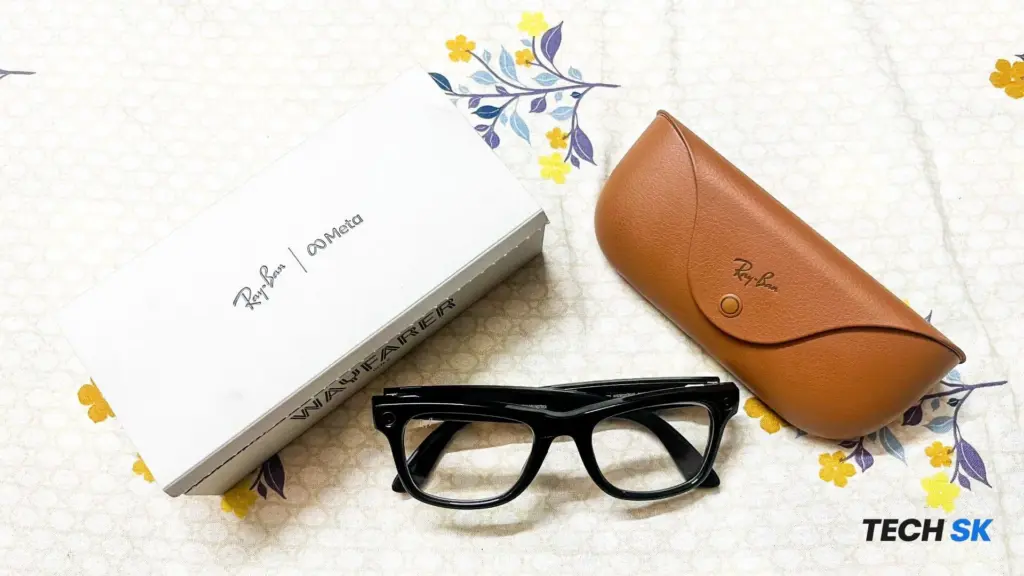
Visually, there is no major design change between the two generations. Both are available in Wayfarer, Headliner, and Skyler styles.
That continuity keeps the product identity intact, although the Gen 2 case is considered more refined than the one that comes with Gen 1. The overall look still stays close to the original formula.
Core specs stay close, too
The internal storage is identical at 32 GB for both models. Each also uses a custom 5-microphone array for audio and voice interaction.
Connectivity gets a modest upgrade. Gen 1 supports Wi‑Fi 6 and Bluetooth 5.2, while Gen 2 moves to Wi‑Fi 6E and Bluetooth 5.3.
System compatibility remains the same on both sides, with support for iOS 14.4 or Android 10 and above. On the audio side, Gen 1 is listed with two custom open-ear speakers, while the Gen 2 specification table does not spell out that detail as clearly.
Who should actually upgrade?
Gen 2 is the stronger product overall, especially for users who care about longer battery life and better video capture. Those two areas are where daily use benefits most.
Still, Gen 1 remains a valid option for anyone who wants into the Ray-Ban Meta ecosystem without paying the higher price. With the same design language, the same processor, and a still-competitive baseline, it continues to make sense for everyday use.
For current Gen 1 owners, the upgrade path is not urgent. If the main needs are audio, basic camera use, and routine smart features, Gen 1 still holds up without requiring a move to the much more expensive model.
Source: tech.sportskeeda.com