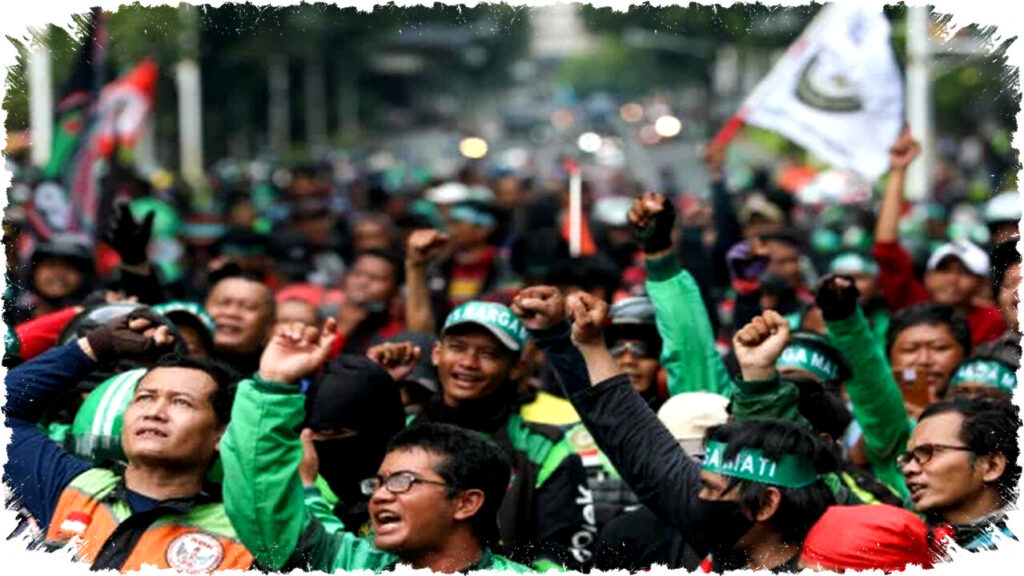
The Bonus Hari Raya (BHR) for online motorcycle taxi drivers (ojol) in 2026 is expected to remain stagnant, according to the Center of Economic and Law Studies (Celios). This situation arises primarily from the limited financial capacity of the ride-hailing platforms, which restricts their ability to provide higher and more equitable bonuses to all drivers. The implications of this stagnant bonus scheme could be significant, potentially sparking renewed protests among drivers who are dissatisfied with the current system.
The Ministry of Manpower (Kemnaker) is still in the process of drafting technical regulations regarding the BHR for ojol drivers. However, Celios warns that these guidelines may not lead to substantial changes in the bonus structure. Major companies such as GOTO (GoTo Gojek Tokopedia Tbk.), Grab Indonesia, and Maxim have confirmed the continuation of the BHR program. Despite this, frustrations are likely to persist because the size and distribution of bonuses tend to favor a small group of high-performing drivers, while the majority receive only minimal amounts.
Reason for Bonus Stagnation: Financial Constraints of Platforms
Celios’ Digital Economy Director, Nailul Huda, explains that the bonus stagnation is due to platforms’ struggle to offer uniform and meaningful bonuses to all drivers. “We see the size of the BHR and recipient criteria remaining the same as last year. Some drivers get a significant amount, but the majority receive the lowest possible bonus,” Huda stated on January 30, 2026. Platforms face financial pressure that limits their capacity to increase the bonus amounts without compromising their operational sustainability.
This financial limitation results in a discriminatory bonus system. Drivers with higher activity levels or performance metrics usually obtain larger bonuses, while others receive the minimum—reported in past years to be as low as approximately Rp50,000 (around $3.20 USD). Such disparities potentially undermine solidarity and exacerbate dissatisfaction among the driver community.
Tension Between Financial Constraints and Driver Welfare
The bonus program, while politically expedient, merely serves to placate short-term unrest and does not address the broader issue of driver welfare. Huda emphasizes that these bonuses do not function as genuine instruments for improving the financial security of drivers. “Drivers need certainty and fair incentives, rather than temporary relief payments during festive seasons,” he affirmed.
This disconnect between driver expectations and platform capacity highlights an ongoing dilemma in Indonesia’s gig economy. While platforms employ millions of drivers, their status as independent contractors rather than formal employees limits both the companies’ obligations and drivers’ access to labor protections.
Risk of Protests and Driver Discontent
Celios predicts a strong possibility of protests similar to those seen in previous years. Drivers who receive the lowest bonuses are likely to express dissatisfaction publicly. “I anticipate complaints and dissatisfaction because the difference in bonus amounts remains striking,” said Huda. In prior years, this divide has fueled collective grievances and calls for improved working conditions and recognition.
The dissatisfaction largely stems from the perception of unfairness. Drivers want transparent, predictable, and fair bonus mechanisms that reward their efforts equitably. However, the current system, prone to favoritism and significant variation, fosters resentment instead.
Future Outlook and Recommendations
As the government finalizes the BHR regulation framework, Celios calls for a more inclusive and transparent approach. They recommend establishing clear criteria underpinning bonus allocations to foster wider acceptance among drivers. Specifically, the following points are critical:
- Transparency: Platforms should disclose the criteria and calculation methods for bonuses clearly.
- Fairness: Bonuses must reflect effort and performance but avoid widening disparities that alienate most drivers.
- Sustainability: Bonus programs should align with platforms’ financial realities without sacrificing driver welfare.
- Government Oversight: Regulations should enforce minimum standards to protect driver interests during festive seasons.
- Long-term Welfare Focus: Policymakers and platforms must consider broader social protection schemes beyond one-time bonuses.
Meeting these objectives would reduce the likelihood of recurrent unrest and contribute to improving the livelihoods of millions of ojol drivers.
With millions relying on motorcycle taxi services for income, the stakes are high. Ensuring a fair and adequate Bonus Hari Raya will be vital not only to maintain operational harmony but also to enhance social equity in Indonesia’s rapidly evolving digital economy. The coming months will reveal whether the government and ride-hailing platforms can implement solutions that balance financial feasibility with driver demands for dignity and fairness.