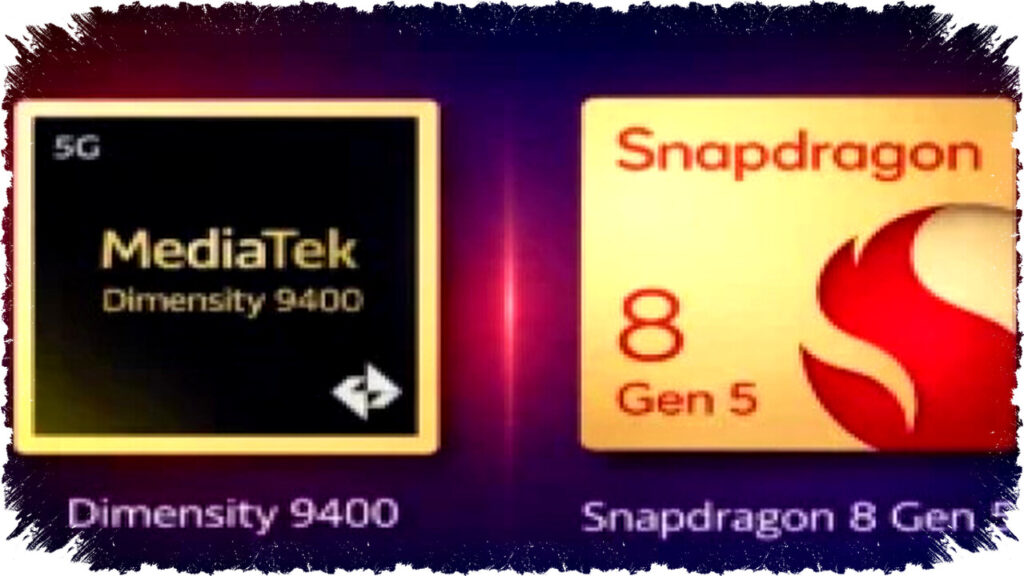
The battle between flagship chipsets in 2026 is fierce, with MediaTek’s Dimensity 9400 and Qualcomm’s Snapdragon 8 Gen 5 leading the charge. Both chipsets utilize advanced 3nm fabrication technology from TSMC, marking a new era in mobile processor capabilities. However, subtle differences in architecture and fabrication nodes create a competitive landscape where determining the fastest 3nm chipset requires careful analysis.
MediaTek launched the Dimensity 9400 in October 2024, emphasizing an “all-big-core” CPU design aimed at maximizing multi-core performance. Qualcomm followed with the Snapdragon 8 Gen 5 in November 2025, boasting an integrated architecture focused on balancing peak performance and energy efficiency. The question arises: which chipset outpaces the other in real-world and benchmark tests?
Fabrication Technology and CPU Architectures
Both chipsets are built on TSMC’s 3nm manufacturing process but differ in specific nodes. The Dimensity 9400 uses TSMC’s N3E node, while Snapdragon 8 Gen 5 employs the N3P node. N3P offers enhanced power efficiency and slightly better performance, giving Qualcomm a manufacturing edge.
The CPU architectures further differentiate these chips. MediaTek adopts a 1+3+4 configuration: one Cortex-X925 core at 3.62GHz, three Cortex-X4 cores at 3.3GHz, and four Cortex-A720 cores operating at 2.4GHz. This setup aims for sustained high performance by relying solely on high-performance cores.
In contrast, Snapdragon 8 Gen 5 uses a 2+6 design based on Qualcomm’s custom Oryon cores. It features two powerful Oryon cores clocked at 3.8GHz and six additional Oryon cores at 3.32GHz. This configuration prioritizes a balance between raw speed and energy efficiency.
Benchmark Performance Comparison
Testing these chipsets on flagship devices—Vivo X200 Pro (Dimensity 9400) and OnePlus 15R (Snapdragon 8 Gen 5)—provides practical insights. Geekbench scores reveal Snapdragon leads in multi-core performance, achieving 9,352 points—a 9% advantage over Dimensity’s 8,592 points. Single-core performance is closer, with Snapdragon at 2,837 compared to Dimensity’s 2,713, marking a 4.5% difference.
AnTuTu benchmarks show a similar pattern of Qualcomm’s dominance. The Snapdragon 8 Gen 5 approaches nearly 3 million points (2,961,236), while Dimensity 9400 scores around 2.7 million (2,713,650), maintaining approximately a 9% lead. Qualcomm’s higher CPU score (+7%) and GPU score (+5%) contribute to this consistent advantage. Memory and UX metrics also favor Snapdragon slightly, suggesting a more optimized system experience.
Camera and Connectivity Features
Performance raw numbers do not tell the full story. Each chipset includes advanced imaging and connectivity capabilities affecting user experience. The Snapdragon 8 Gen 5 features the Qualcomm Spectra triple AI ISP, a 20-bit system supporting 4K video recording at 120fps and unlimited real-time semantic segmentation. These features enhance photo and video quality through advanced computational photography.
Conversely, the MediaTek Dimensity 9400 uses the Imagiq 1090 ISP, capable of handling up to 320MP photos and enabling 8K video recording at 60fps. While it also supports real-time semantic segmentation, its strength lies in high-resolution imaging and ultra-high-definition video capture.
In terms of connectivity, the Snapdragon chipset leverages the Snapdragon X50 5G modem with maximum download speeds of 10 Gbps and upload speeds up to 3.5 Gbps. MediaTek’s modem supports 7 Gbps downloads, a notable but smaller figure. Interestingly, MediaTek offers faster Wi-Fi 7 speeds (7.3 Gbps) compared to Snapdragon’s 5.8 Gbps, indicating design trade-offs between cellular and Wi-Fi performance.
Summary of Key Comparison Points
| Feature | Dimensity 9400 | Snapdragon 8 Gen 5 |
|---|---|---|
| Fabrication Node | TSMC N3E | TSMC N3P |
| CPU Architecture | 1 Cortex-X925 + 3 Cortex-X4 + 4 Cortex-A720 | 2 Oryon cores + 6 Oryon cores |
| Single-Core Geekbench Score | 2,713 | 2,837 |
| Multi-Core Geekbench Score | 8,592 | 9,352 |
| AnTuTu Score | 2,713,650 | 2,961,236 |
| Max 5G Download Speed | 7 Gbps | 10 Gbps |
| Max Wi-Fi Speed | 7.3 Gbps | 5.8 Gbps |
| Max Camera Resolution | Up to 320MP | Not specified, but advanced ISP |
| Video Recording Capability | 8K at 60fps | 4K at 120fps |
Implications for Users and the Industry
Snapdragon 8 Gen 5’s stronger multi-core performance and superior 5G modem make it well-suited for users demanding extreme gaming performance and future-proof connectivity. Qualcomm’s edge in fabrication efficiency and architectural design results in peak speed benchmarks that are difficult to surpass.
Meanwhile, MediaTek’s Dimensity 9400 offers competitive processing power with an “all-big-core” design that sustains high throughput. Its imaging system favors ultra-high-resolution photos and 8K video capture, targeting multimedia enthusiasts. The faster Wi-Fi support may also appeal to users prioritizing local wireless speed.
Everyday users may find the differences in raw performance negligible during casual tasks like browsing and social media. However, for intensive workloads like high-end gaming, AI processing, or 4K/8K video editing, Snapdragon’s gains may materialize into tangible benefits.
As both MediaTek and Qualcomm continue innovating within the 3nm node framework, this rivalry pushes the entire smartphone industry forward. Devices powered by these chipsets will set the benchmark for flagship smartphones released in the coming years.
In conclusion, Snapdragon 8 Gen 5 currently holds the title of the fastest 3nm chipset thanks to its efficient N3P node, robust CPU configuration, and cutting-edge 5G modem. Dimensity 9400 remains a formidable competitor with its balanced performance and advanced imaging credentials, sustaining a healthy and evolving chipset landscape for consumers and manufacturers alike.