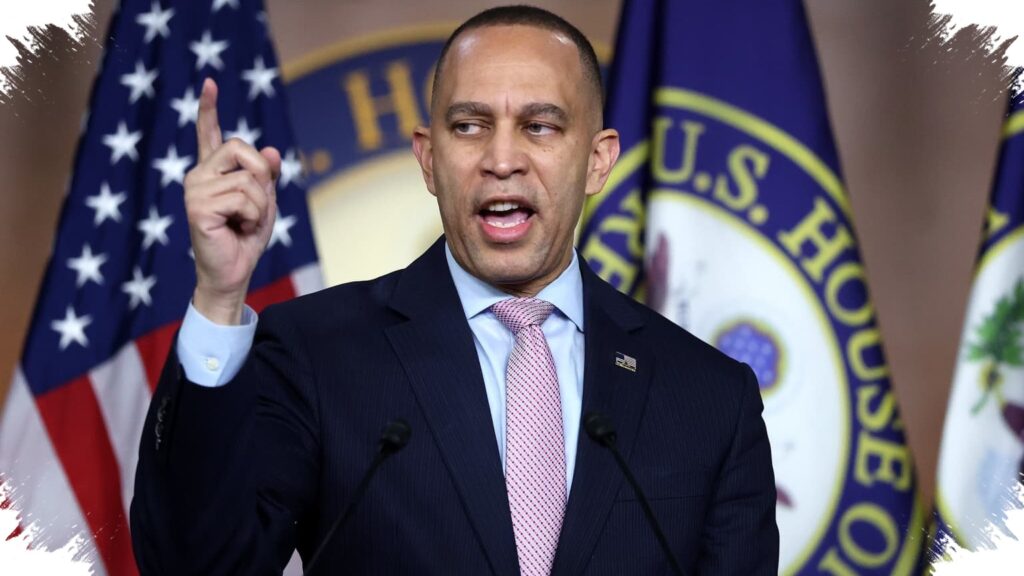
House Minority Leader Hakeem Jeffries is pushing back hard as the redistricting fight intensifies ahead of the midterm elections. He told House Democrats to prepare for a “massive Democratic redistricting counteroffensive” and scheduled a caucus-wide meeting for Thursday in Washington, D.C.
The move comes after a series of legal and political setbacks that have shifted momentum toward Republicans. Democrats now say the fight over congressional maps is far from over, and they are weighing court action, legislation, and new map strategies in response.
Democrats regroup after legal setbacks
Jeffries laid out the stakes in a letter to the House Democratic caucus after recent court rulings complicated the party’s plans. The Virginia Supreme Court struck down a referendum that would have opened the door to new congressional maps in the state, which Democrats said could have given them as many as four additional seats.
Virginia Democrats responded by asking the U.S. Supreme Court to pause that ruling. A week earlier, the Supreme Court also weakened a section of the Voting Rights Act, a decision that could allow GOP-led states in the South to redraw districts and remove Democrat-controlled majority-minority seats.
Those developments have strengthened Republican prospects in the House map battle. Democrats had been seen as strong contenders to win back the chamber, but the legal changes have made the path harder and given Republicans more room to protect their majority.
Jeffries signals a broader Democratic response
Jeffries said Democrats will not sit still while Republicans pursue new district lines. In his letter, he argued that “the failed GOP majority will not be able to gerrymander themselves back into power,” and said Democrats would still take control of the House in November.
The caucus briefing on Thursday will include Rep. Joe Morelle of New York, the top Democrat on the House Administration Committee, which oversees federal elections. Morelle has also been part of Democrats’ early redistricting efforts at the state level.
Jeffries sent Morelle to New York last week to speak with Gov. Kathy Hochul and state lawmakers about possible redistricting for the 2028 elections. Jeffries also named New York, Colorado, Washington and Maryland as states that are taking steps to respond to what he called the fallout from the Supreme Court’s ruling.
Republicans hold the current advantage
Republicans have gained the upper hand in the mid-decade redistricting push, according to an analysis by Issue One, a bipartisan group that studies political influence. The group said the GOP could pick up as many as 12 additional House seats through new maps.
That edge has been built in part by state-level action in the South. Tennessee Gov. Bill Lee recently signed a map that eliminated the state’s only Democrat-held district, and Alabama, Louisiana and South Carolina have also moved to redraw their maps after the court’s Voting Rights Act decision.
The redistricting battle began after Donald Trump urged Texas and other GOP-led states to pursue more favorable maps as Republicans faced a more difficult political landscape. In response, Democratic-led California and Virginia launched their own redistricting efforts, and voters in both states approved referendums allowing new maps.
Democrats point to broader political headwinds for Trump and Republicans
Even with the setbacks, Democrats are arguing that the political environment still offers them a path forward. Jeffries pointed to Trump’s weak favorability ratings, public frustration over rising prices, and criticism tied to the war in Iran as reasons for optimism.
He said Republicans are focused on changing district lines because they have failed to improve conditions for voters. That argument is expected to remain central as Democrats prepare for the Thursday meeting and continue searching for ways to answer GOP map gains.
Congressional redistricting usually happens once a decade after the U.S. Census, but the current fight has turned into an unusual mid-decade contest with major stakes for control of the House. With court rulings, state referendums, and new maps all moving at once, both parties are treating the battle as a crucial part of the road to the midterms.
Read more at: www.cnbc.com