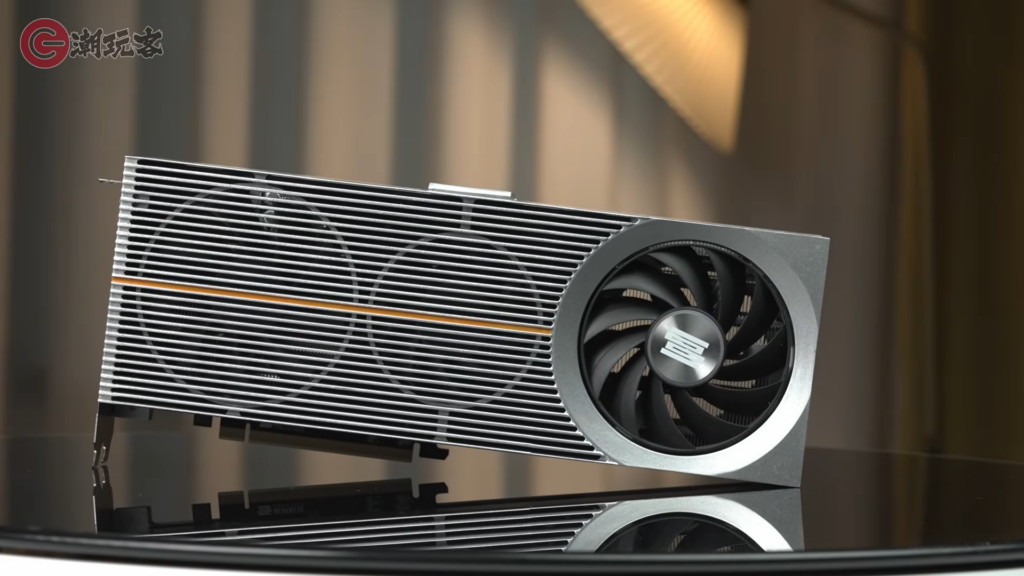
Lisuan’s LX 7G100 is emerging as a notable sign that China’s homegrown gaming GPU efforts are moving past the stage of driver trouble and into practical use. The card can already handle modern games and AAA titles with far better smoothness than earlier Chinese GPUs, even if it still falls short of the performance level set by established mainstream products.
That progress matters because compatibility has often been the biggest obstacle for local GPUs. With the LX 7G100, modern games can now launch and run without months of waiting for driver fixes, which has long been a frustration for this market.
Better compatibility, but not yet mainstream-class performance
The LX 7G100 is built on Lisuan Tech’s TrueGPU architecture and comes with 12 GB of GDDR6 memory. It uses a 6 nm chip called 7G106, and its 1080p gaming results show that it is already usable for real-world play.
In Black Myth: Wukong, the card reached 56 FPS. It also scored 57 FPS in The Witcher 3: Wild Hunt, 80 FPS in Elden Ring, 150 FPS in Grand Theft Auto V, and 182 FPS in Dota 2.
Cyberpunk 2077 showed stronger numbers with FSR3 Quality mode and frame generation enabled, where performance climbed to around 88 FPS. Even so, that level still leaves the card roughly 30% behind mainstream options such as the Nvidia GeForce RTX 4060 and Intel Arc B580.
The gap gets wider in harder-to-optimize games
The LX 7G100 does not struggle equally across every title. In games with poor optimization support, the performance gap becomes much more obvious, and competing GPUs can deliver frame rates that are two to three times higher.
That means the card is now good enough to be considered a gaming product, but it is not yet in a comfortable position to challenge well-established midrange rivals. The hardware has made a clear leap, but it still lacks the consistency needed to stand alongside the better-known names in the same class.
Software maturity is still the main issue
The biggest improvement for the LX 7G100 is not only raw speed, but software maturity. Modern games now run far more smoothly than they did on older Chinese GPUs, which often ran into compatibility problems before a game could even start properly.
At the same time, several issues remain. Testers still found stuttering, uneven frame pacing, a driver control panel that is nearly empty, and overclock settings that reset to zero after every reboot. Those weaknesses make the user experience less stable, especially for gamers who want to tune performance manually.
Lisuan has also not added hardware support for ray tracing to this GPU. The company plans to bring that feature to a future generation instead.
Price keeps the pressure on
The LX 7G100 faces another challenge beyond performance and software: pricing. In China, the Founders Edition is set at around $485, which places it close to other options from Nvidia, AMD, and Intel that are substantially faster.
That makes the value proposition harder to defend. Lisuan now has to prove not only that its GPU is compatible with modern games, but also that it offers enough performance and overall value to compete in a crowded price range.
For now, the LX 7G100 stands as an important milestone for Chinese gaming GPUs. It shows that compatibility is no longer the same barrier it once was, but the roughly 30% performance gap versus the RTX 4060 and the remaining software issues still keep it clearly behind the mainstream field.
Source: www.notebookcheck.net