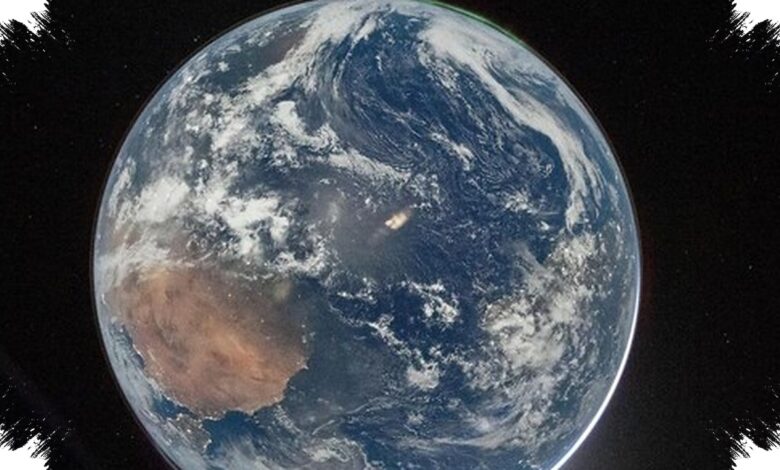
Earth’s plant life may face its ultimate limit long before the Sun expands into a red giant. A study estimates that declining atmospheric carbon dioxide could end the survival of plants in roughly 1.35 billion years under one future scenario.
The finding shifts attention from the distant red giant stage to a slower process already built into Earth’s long-term climate system. Plants need carbon dioxide for photosynthesis, so a severe decline in that gas could become fatal for complex life.
Carbon Dioxide Could Become the Decisive Limit
The researchers examined 29 climate models to explore how Earth’s biosphere could change over extremely long timescales. Their simulations tested both excessive planetary heating and conditions in which carbon dioxide becomes too scarce to support plant life.
| Scenario | Estimated Plant-Life Limit | Main Condition |
|---|---|---|
| Carbon dioxide remains unchanged | Up to 1.87 billion years | CAM photosynthesis plants may persist gradually |
| Carbon dioxide declines | About 1.35 billion years | Carbon dioxide becomes insufficient for plants |
In the declining-carbon-dioxide scenario, the availability of the gas becomes a stricter limit than Earth’s ability to keep temperatures stable. Plants would no longer have enough carbon dioxide to sustain photosynthesis.
The study, published in JGR Atmospheres, describes the maximum lifetime of Earth’s biosphere as constrained by the Sun’s increasing brightness. As the Sun becomes brighter, Earth receives more energy and faces growing heat pressure.
Earth’s Climate Response Has a Trade-Off
Over long periods, Earth’s carbon system responds to increased solar energy by removing carbon dioxide from the atmosphere and storing it in carbonate rocks. This process can reduce the greenhouse effect and help counter rising solar radiation.
However, the same response creates a serious biological trade-off. Lower atmospheric carbon dioxide makes it harder for plants to maintain the photosynthesis that supports their survival.
If carbon dioxide does not decline in the model, plant life could remain viable for as long as about 1.87 billion years. Plants using CAM photosynthesis, also known as crassulacean acid metabolism, are expected to endure the longest in that case.
CAM photosynthesis therefore provides an important contrast between the two modeled futures. The difference between the estimates shows that plant survival depends not only on warming, but also on how different photosynthetic pathways respond to carbon dioxide scarcity.
Earlier Estimates Pointed to a Shorter Window
Previous research had suggested that the end of plant life could arrive much sooner, around 100 million years from now. That estimate was linked to disruption in Earth’s carbonate-silicate cycle.
Yet the projected timing can extend to around 1.5 billion years because plants do not all use the same photosynthetic process. Some types are expected to tolerate falling carbon dioxide better than others.
The researchers cautioned that their calculation is based on currently known photosynthetic performance. It does not account for the possibility that photosynthesis could evolve over the very distant future.
“We acknowledge that the results of this study need to be examined with other 3D models,” the researchers wrote. They added that comparisons involving high and low insolation models could help narrow the projected timescale of biosphere change.
The study does not assign a single final date for life on Earth. Instead, it shows how solar brightening, the carbon cycle, atmospheric carbon dioxide, and CAM photosynthesis may shape the planet’s biological limit well before the red giant phase.