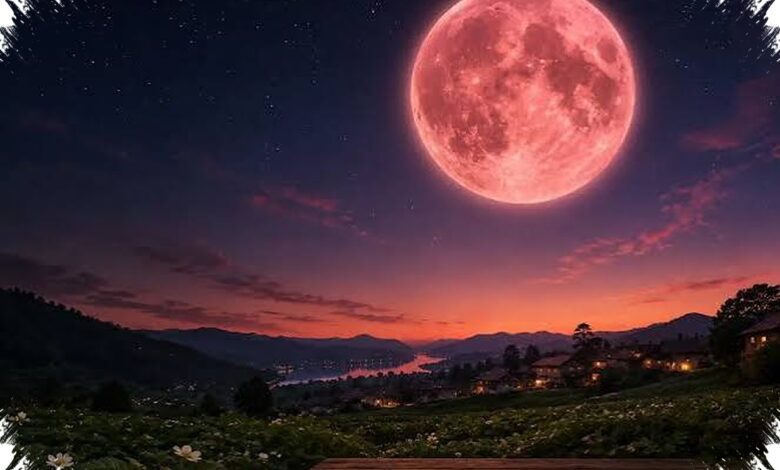
Observers will have a chance to spot Venus beside a thin young crescent Moon in the western evening sky on Friday, July 17, 2026. The pairing is expected to be visible without a telescope if the sky is clear and the horizon is unobstructed.
Venus is expected to be the brightest object in the scene. Its strong light should make it a useful guide for locating the much thinner crescent Moon nearby as twilight fades.
The most suitable viewing window is estimated at about 20 to 60 minutes after sunset. During that period, the sky becomes dark enough for the objects to stand out while both remain visible in the west.
What to Look For After Sunset
| Object or Detail | What to Expect | Where to Look |
|---|---|---|
| Young crescent Moon | A thin crescent near Venus | Western sky |
| Venus | The brightest object in the evening view | Western sky |
| Viewing time | About 20–60 minutes after sunset | After twilight begins |
Observers should wait until the Sun has fully set before looking toward the western horizon. This is important for eye safety when viewing an area of sky close to where the Sun disappeared.
A location with a clear western view will offer the best chance of seeing the two objects. Tall buildings, trees, thick clouds, and bright surrounding lights can make the view less comfortable or block the low horizon.
An Apparent Meeting, Not a Close Encounter
The event is known in astronomy as a Moon-Venus conjunction. The term describes two celestial objects that appear close together in the sky when seen from Earth.
The Moon and Venus will not actually be close to each other in space. Their apparent proximity is produced by the observer’s line of sight, even though the two bodies are separated by a very large distance.
Such events provide a simple opportunity to identify familiar objects in the solar system. The contrast between the slender Moon and bright Venus can be recognized with the naked eye under supportive weather conditions.
Why Venus Stands Out
Venus is often called the Morning Star or Evening Star because it can shine prominently at certain times of day. Despite the nickname, it is not a star but a planet in the solar system.
Its distinctive brightness is the central feature of the July 17 view. Once Venus is found in the west, observers can search nearby for the slim arc of the young crescent Moon.
Binoculars or a telescope may help reveal the Moon’s crescent shape in greater detail. However, optical equipment is not required to enjoy the visual pairing, as both objects can be identified without it.
A Simple Skywatching Opportunity
Media Indonesia noted that events of this kind can be observed directly by the public. Their accessibility makes them suitable for family activities as well as for people beginning to explore astronomy.
The scene may also appeal to photographers seeking an evening composition. The fading twilight, a delicate crescent Moon, and Venus as a bright point can appear together in a single frame.
Each recurring astronomical event takes place under different observing conditions. Clear weather and an open western horizon will therefore be important for anyone planning to look for Venus and the young crescent Moon on July 17, 2026.