

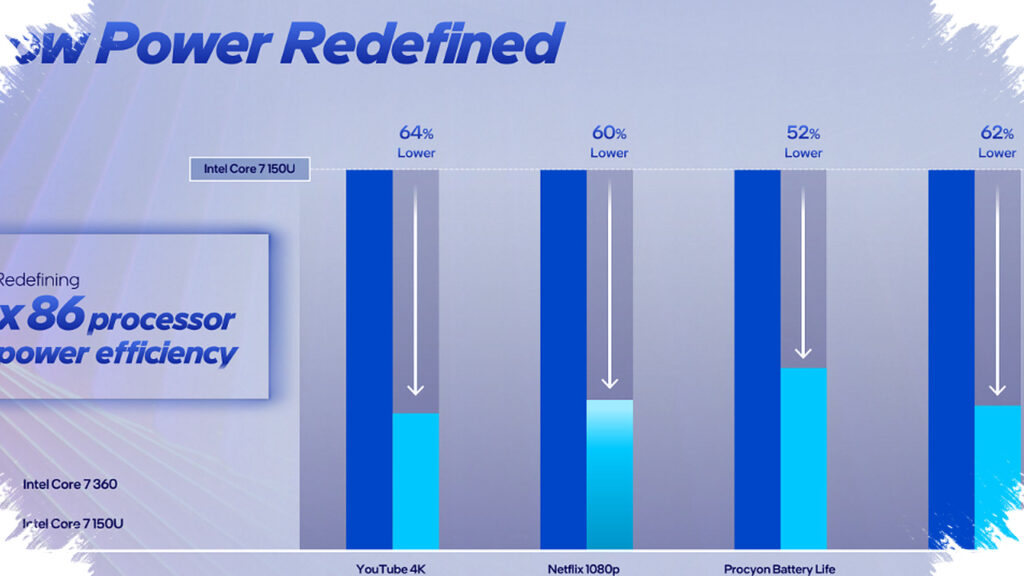
Intel has begun offering a clearer look at Wildcat Lake, a new direction for thin-and-light laptops that appears to prioritize power efficiency over raw speed. The reference unit shown by Notebookcheck was not a final commercial product, but it already signaled the kind of machines Intel wants this chip to serve: compact notebooks for everyday computing with lower power demand.
The most notable point is that Wildcat Lake is not trying to compete at the top end of performance. Instead, Intel seems to be trimming both CPU cores and integrated graphics to create a platform that fits slimmer designs, quieter operation, and more modest workloads.
A leaner chip under the Panther Lake umbrella
Notebookcheck describes Wildcat Lake as a Panther Lake variant without the “Ultra” label. That positioning comes with a simpler configuration, including fewer CPU cores, a weaker iGPU, and more conservative power limits.
This approach places the chip squarely in the thin-and-light category. The goal appears to be portability and efficiency, rather than sustaining heavy workloads for long stretches.
What the reference laptop reveals
The reference laptop Intel showed uses an aluminum chassis. Notebookcheck also noted that the keyboard styling gives off a MacBook-like impression, at least in terms of the overall visual feel.
Because it is a reference design, the machine should be viewed as a platform demonstration rather than a final retail model. Even so, it gives a useful preview of Intel’s intended direction for the upcoming chip family.
Core layout points to an efficiency-first design
Inside the device is an Intel processor that has not been officially identified, but the configuration is already visible. It combines 2 Cougar Cove P-cores with 4 Darkmont LPE-cores, for a total of 6 cores.
That setup shows a clear trade-off. Intel seems to be keeping enough processing capacity for routine tasks while avoiding the higher power draw associated with more aggressive designs.
The main specifications seen on the unit include:
- 6-core CPU: 2 Cougar Cove P-cores + 4 Darkmont LPE-cores
- PL1: 17 W, with up to 22 W maximum
- PL2: 35 W
- 11 W TDP for fanless systems
- NPU: 17 TOPS
- iGPU: 2-core
- RAM: 16 GB onboard
Fanless use is part of the plan
One of the more interesting details is Intel’s suggestion that the chip can operate without active cooling. In that mode, the TDP is limited to 11 W, which opens the door to thinner and quieter notebooks.
That matters because fanless operation can reduce noise and simplify thermal design. It also hints at a product class aimed at basic productivity, AI-assisted tasks, and general mobility rather than sustained performance workloads.
Notebookcheck said it had not yet carried out full testing on the unit, so real-world behavior in fanless use remains unverified. The reference machine still serves mainly as an early indicator of the platform’s intended balance between heat, power, and usability.
The GPU side is intentionally restrained
The integrated graphics also follow the same pattern. Wildcat Lake uses a 2-core iGPU, another sign that Intel is not trying to position this chip for heavy graphics work.
For everyday computing, that may be enough when combined with the NPU and the low-power CPU layout. The design appears to favor battery-friendly operation and compact hardware over higher graphics throughput, which would normally increase heat and power consumption.
Which chip might it be?
Intel has not confirmed the exact processor model in the reference laptop. Still, Notebookcheck pointed to the 17 TOPS NPU as an important clue, since that specification matches either the Core 7 360 or Core 7 350.
The site noted that the CPU core arrangement alone is not enough to identify the SKU with certainty. For now, the processor remains an informed guess based on the visible hardware characteristics rather than an officially confirmed model.
Wildcat Lake therefore looks like Intel’s answer for manufacturers that want a flexible, low-power option for slim notebooks. The reference system already shows the direction clearly: fewer cores, limited graphics, modest power targets, and the possibility of fanless designs for portable devices.