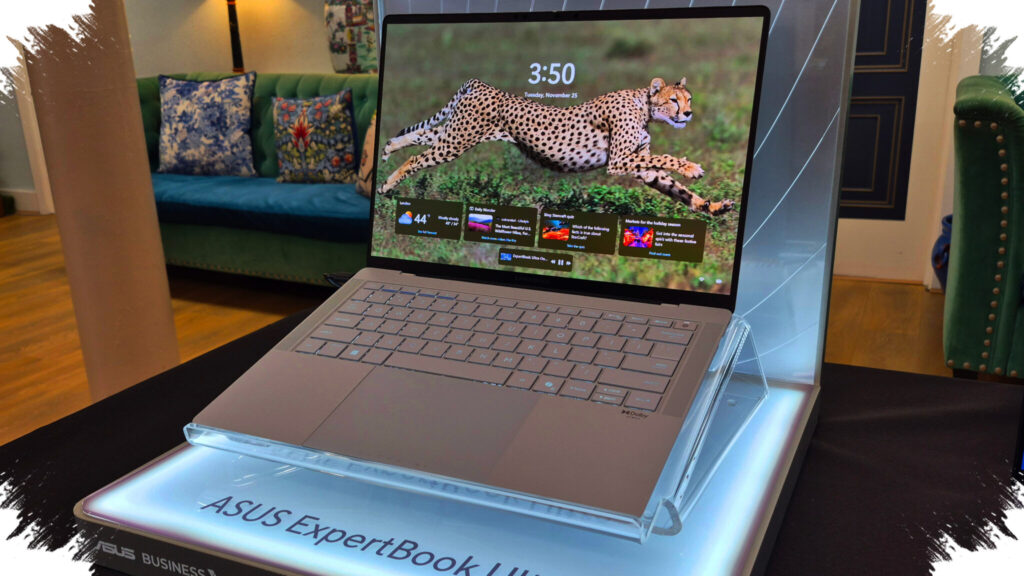
A slim business laptop that is expected to move from desk to bag to meeting room usually faces a very ordinary kind of punishment. Asus is taking a different approach with the ExpertBook Ultra, turning durability into the main story and backing it with 157 extreme tests.
That focus matters because the device is aimed at users who need a lightweight machine without giving up resilience. Asus positions the ExpertBook Ultra as a premium business laptop built to handle daily travel, repeated handling, and the kinds of stress that often damage thinner devices.
Built for heavy use, not just a polished look
Asus says the ExpertBook Ultra has passed MIL-STD-810H military certification through 24 testing procedures across 11 categories. The laptop is also claimed to withstand up to 100 kg of load, which puts its durability claims well above what is usually associated with thin business laptops.
The testing goes beyond simple pressure checks. Asus says the device has been evaluated for operation at altitudes of up to 15,000 feet, for temperature swings from -51 degrees Celsius to 60 degrees Celsius within hours, and for 18 hard physical shocks.
Ceramic-like outer layer and a lighter internal frame
The outer surface uses nano ceramic technology with a Plasma Electrolytic Oxidation, or PEO, process. That treatment creates a ceramic-like oxide layer on the body, and Asus says it reaches 9H hardness and offers five times better scratch resistance than the 3H industry standard.
Asus also says the surface can survive more than 60,000 cycles of hand pressure, which is meant to account for repeated contact, friction, and everyday wear. Inside, the company uses an AZ31B magnesium-aluminum frame, a material known in aerospace and Formula 1 applications for combining low weight with structural strength.
According to Asus, that alloy helps make the device 34 percent lighter without sacrificing structural integrity. For a laptop that is likely to be carried often, that balance between weight and strength is central to the design.
Display, hinge, and keyboard are reinforced too
The protection does not stop at the chassis. The ExpertBook Ultra uses a Tandem OLED panel covered with Gorilla Glass Victus, adding another layer of physical defense to the display.
Asus says the screen can withstand scratch-related load up to 100 kg. The hinge is also said to have passed 50,000 extreme open-and-close cycles in internal testing, which suggests the company is treating moving parts with the same attention as the body shell.
The keyboard is built with spill resistance and drainage paths designed to move liquid away from sensitive components. Asus also tested the C-part area with 60,000 wool rub cycles and the keycaps with 250,000 rub cycles to check long-term surface durability.
Ports and internal parts are reinforced against daily accidents
Even the I/O ports have been strengthened. Asus uses thick metal shielding on the inside of the port section to help prevent the motherboard from cracking if a cable is pulled forcefully.
That detail shows the durability plan is aimed at more than certification labels. The ExpertBook Ultra is meant to handle common workday risks such as cable tugs, bumps during transport, and repeated use on a busy desk.
With nano ceramic protection, an AZ31B magnesium-aluminum frame, Gorilla Glass Victus, and a long list of military and internal tests, Asus is clearly placing the ExpertBook Ultra in the premium business category where thin design and physical toughness are expected to coexist.