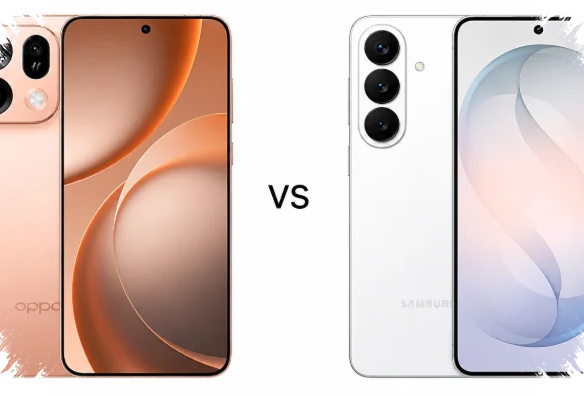
A flagship showdown is increasingly being decided by practical strengths rather than raw performance alone, and that shift puts Oppo Find X9s in a compelling position against the Samsung Galaxy S26. Oppo is pushing a combination of a much larger battery, a more evenly matched camera setup, and a lower entry price, while Samsung leans on stronger silicon, a more premium build, longer software support, and video features that still matter to power users.
The pricing gap is one of the clearest signs of how different these two phones are. Oppo Find X9s starts at ₹60,000 ($730), while the Samsung Galaxy S26 is listed around ₹88,000 ($900), which gives Oppo a strong value angle for buyers who want flagship-level hardware without paying top-tier premium pricing.
Display and durability take different routes
On the front, Oppo uses a 6.59-inch AMOLED panel with a 120Hz refresh rate, Dolby Vision, and peak brightness rated at 3600 nits. Samsung answers with a 6.3-inch Dynamic LTPO AMOLED 2X display, also running at 120Hz, with HDR10+ support and 2600 nits of brightness.
That means Oppo has the edge in size and brightness, while Samsung keeps the more compact form factor. Both phones are built for premium use, but they approach protection differently, too.
Samsung Galaxy S26 relies on Gorilla Glass Victus 2 on the front and back, Armor Aluminum 2 for the frame, and an IP68 rating. Oppo Find X9s uses Gorilla Glass 7i, an aluminum frame, and IP68/IP69 certification, giving it a broader claim in water and dust resistance.
Performance favors Samsung, while software support stretches further
Inside, Oppo Find X9s runs on the MediaTek Dimensity 9500s built on a 3nm process. Samsung Galaxy S26 is powered by Snapdragon 8 Elite Gen 5 or Exynos 2600 depending on the market, which puts it ahead in raw flagship processing strength.
Samsung also extends its lead through software policy. The Galaxy S26 ships with Android 16 and a promise of up to 7 major Android upgrades, while Oppo Find X9s arrives with Android 16 and ColorOS 16, but without the same long upgrade commitment.
Both phones come with 12GB of RAM. For storage, Oppo offers 256GB and 512GB options with UFS 4.1, while Samsung provides 128GB, 256GB, and 512GB variants with UFS 4.X.
Camera hardware is where Oppo looks more ambitious
The rear camera setup is one of the most interesting contrasts. Oppo Find X9s uses three 50MP cameras for wide, telephoto, and ultrawide shooting, while Samsung Galaxy S26 combines a 50MP wide camera with a 10MP telephoto and a 12MP ultrawide.
That gives Oppo a more balanced arrangement on paper, especially because its telephoto and ultrawide sensors are both higher in resolution. The telephoto module also supports 3x optical zoom, matching Samsung’s 3x optical zoom but with a 50MP sensor instead of 10MP.
The ultrawide camera follows the same pattern, with Oppo again using 50MP compared with Samsung’s 12MP. On the front, Oppo includes a 32MP selfie camera with 4K 60fps recording, while Samsung uses a 12MP front camera with 4K 60fps support.
Samsung still keeps one major edge for creators who care about video. The Galaxy S26 supports 8K recording and HDR10+, while Oppo tops out at 4K with up to 120fps and Dolby Vision.
Battery and charging create the biggest gap
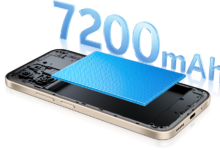
The largest difference between the two phones is battery capacity. Oppo Find X9s carries a 7025mAh battery, far ahead of the Samsung Galaxy S26’s 4300mAh cell, and that alone makes Oppo the more obvious pick for users who want longer daily endurance.
Charging speeds also favor Oppo, which supports 80W wired charging. Samsung responds with 25W wired charging, but it counters with 15W wireless charging and reverse wireless charging, two features that Oppo does not include.
Connectivity and user priorities
Both phones support Wi-Fi 7, but Oppo adds Bluetooth 6.1, an IR blaster, and NavIC. Samsung comes with Bluetooth 5.4 and DeX, which will appeal to users who want a more desktop-like experience.
Taken together, the two devices target different buyers. Oppo Find X9s is positioned for anyone who values a brighter display, stronger camera hardware across the board, a much larger battery, and a lower starting price, while Samsung Galaxy S26 remains the more traditional premium choice for stronger performance, more refined materials, 8K video, wireless charging, and longer software support.
Source: www.gizmochina.com