POCO’s performance lineup has continued to climb, and the latest AnTuTu results for May 2026 show just how far the brand has pushed its top-tier models. The highest-scoring device in the list reached 3.9 million points, putting it firmly into extreme flagship territory.
That number matters because POCO still carries a reputation for aggressive pricing and strong specifications. In a market where smartphone prices keep rising, the brand remains one of the more attractive options for users who want serious power without moving too far into premium pricing.
Top-end performance now sits very close to premium flagships
The biggest highlight comes from POCO’s upper lineup, where benchmark scores have moved into a range once associated almost entirely with ultra-premium phones. POCO X8 Pro Max posted 3 million points, while POCO F8 Ultra climbed even higher to 3.9 million points.
Those results place both models among the fastest POCO phones recorded in May 2026. They also show how closely the brand’s best-performing devices are approaching the flagship premium class, especially at the very top of the X and F families.
The X Series remains the gaming-focused favorite
For many users, the X Series still stands out as the most appealing balance of price, performance, and gaming capability. Some of the newer models use flagship-class chipsets such as MediaTek Dimensity 8400 Ultra and Dimensity 9500s, supported by up to 12GB of RAM, UFS 4.1 storage, and improved cooling systems.
That hardware combination helps explain the benchmark growth across the series. POCO X5 5G scored 570 thousand points, X5 Pro 5G reached 810 thousand, X6 5G landed at 750 thousand, and X6 Pro jumped to 1.6 million.
The upward trend continues with POCO X7 5G at 850 thousand points and X7 Pro 5G at 1.9 million. POCO X8 Pro 5G then moved to 2 million, before X8 Pro Max pushed even further to 3 million points.
F Series still holds the brand’s highest position
Even with the strong showing from the X lineup, POCO’s F Series remains the brand’s peak performance range. These models are built for users who want the most powerful hardware, with most of them using the latest Snapdragon 8 Series chipsets, large RAM configurations, UFS 4.1 storage, 120Hz AMOLED displays, and vapor chamber cooling.
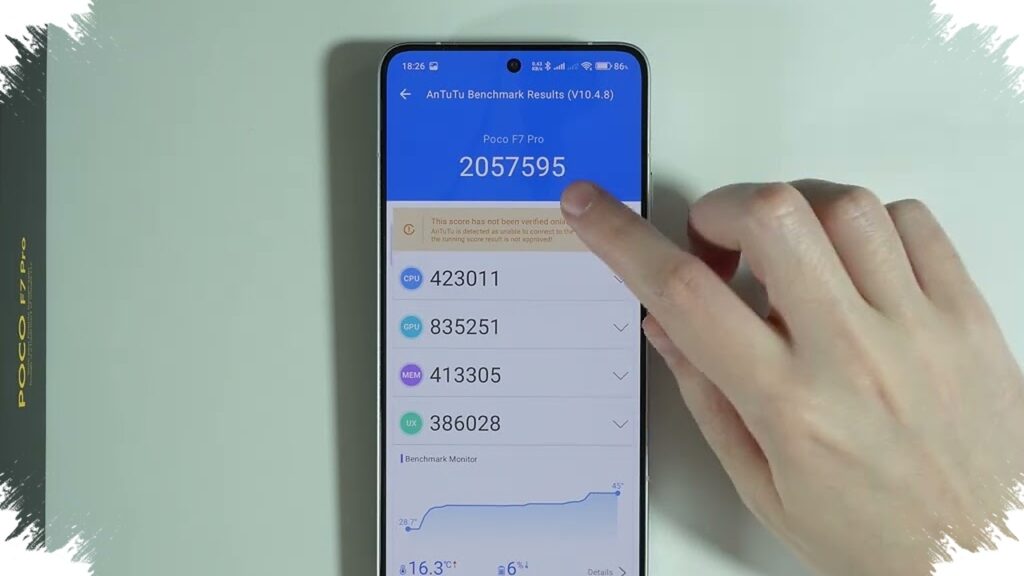
The scores reflect that positioning clearly. POCO F3 and F4 both posted 1 million points, followed by F4 GT at 1.3 million and F5 at 1.2 million. F6 reached 1.7 million, F7 climbed to 2.2 million, and F7 Pro hit 2.3 million.
At the top end, F7 Ultra reached 3 million points, F8 Pro went to 3.2 million, and F8 Ultra topped the list at 3.9 million. That makes F8 Ultra the fastest POCO model in this selection, and the one that most clearly signals the brand’s move into extreme flagship performance.
Entry and mid-range lines still serve different needs
Not every POCO phone is built for benchmark chasing, and the C and M Series continue to target more everyday users. The C Series stays focused on basic needs, with many models using MediaTek Helio G chips such as Helio G85 and Helio G81 Ultra, plus RAM options from 4GB to 8GB.
Its AnTuTu numbers sit in the 320 thousand to 400 thousand range. POCO C71 is listed at 320 thousand, C75 and C85 both at 340 thousand, C65 at 360 thousand, and C81 Pro at 400 thousand points.
The M Series sits one step above that as a more affordable mid-range family with steadier performance. It also relies heavily on MediaTek Helio G chips, but gains from better optimization, while some models add AMOLED screens, UFS storage, and internal capacity of up to 256GB.
That translates into noticeably stronger benchmark results. POCO M6 scored 360 thousand points, M4 Pro and M7 both reached 480 thousand, M6 Pro rose to 530 thousand, and M7 Pro 5G climbed to 650 thousand points.
These figures show a clear ladder across POCO’s lineup, from basic daily use on the C Series to the near-flagship territory of the latest F models. Benchmark scores alone do not tell the full story, though, so battery life, camera quality, cooling stability, and software optimization still matter when choosing the right POCO phone.