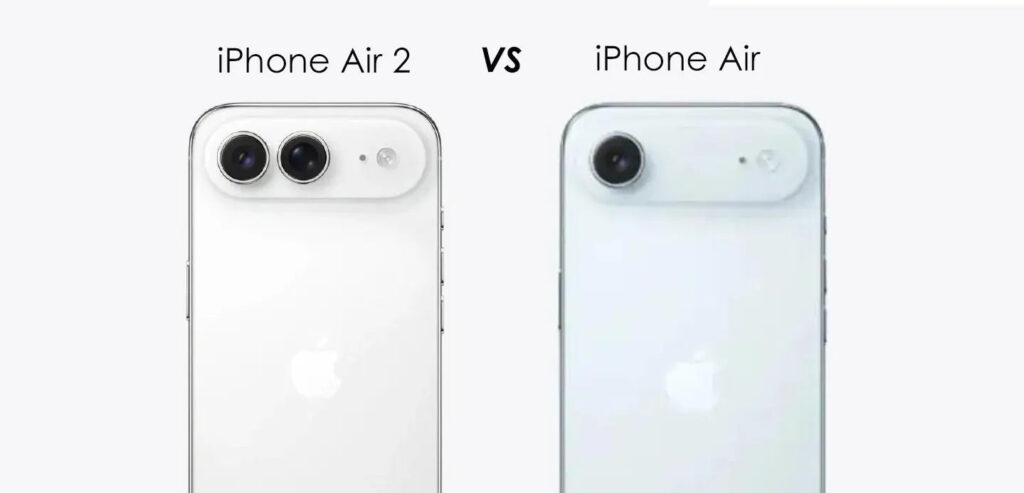
Apple’s iPhone Air line may finally be moving toward a shape that feels more complete. New leaks around iPhone Air 2 suggest that the company is not just chasing extreme thinness, but also addressing the weaknesses that made the first version feel more like a style statement than a fully balanced premium phone.
The most important change is not the design language itself, which remains focused on a very slim body. It is the fact that Apple appears to be pairing that thin profile with upgrades in audio, imaging, battery efficiency, and performance.
A thinner body with a stronger build
iPhone Air 2 is said to measure just 5.5 mm thick, keeping it firmly in ultra-thin territory. Even so, the frame is reportedly made from titanium, a move intended to preserve durability without adding too much weight.
That combination matters because it shows Apple is no longer treating thinness as the only selling point. The idea seems to be to keep the light, premium feel while reducing the sense that an ultra-thin device must automatically accept major compromises.
Apple may also be changing the timing
The launch window being discussed is equally notable. iPhone Air 2 is reportedly planned for early 2027, with March or April being the period currently circulating.
That would place it outside the familiar September cycle that usually defines iPhone launches. The timing also fits Apple’s broader strategy of spreading product updates across two launch periods each year.
The biggest complaints are getting attention
One of the clearest weaknesses in the earlier model was audio. iPhone Air 2 is said to move to stereo speakers, replacing the single-speaker setup that limited the experience on the first generation.
For everyday use, that change would be immediately noticeable. Video playback, music, and hands-free calls would all sound more complete, while spatial audio effects are also expected to benefit.
Camera hardware is getting a more serious update
The camera system is also expected to move forward in a meaningful way. iPhone Air 2 is rumored to feature a dual-camera setup with an added ultra-wide lens, alongside Apple’s 48-megapixel fusion main camera.
That extra lens would give users more flexibility in framing, especially for landscapes, dynamic scenes, and tighter spaces. It also points to sharper results and better low-light performance, while Apple’s computational photography approach is expected to remain central to the final image quality.
For a device this slim, that software support is especially important. Ultra-thin phones often struggle to keep camera hardware from feeling limited, so Apple appears to be relying on imaging processing to help balance the physical constraints of the design.
Efficiency is becoming part of the pitch
Battery life remains a key question for any phone this thin, and Apple appears to be responding with a more efficient internal setup. iPhone Air 2 is said to use the A20 or A20 Pro chip built on a 2 nm process, paired with the new C2 and C2X communication processors.
That combination is reportedly designed to reduce power draw across both light and heavy workloads. In practice, that would help the device feel more realistic as an all-day phone rather than a thin device that constantly asks for trade-offs.
The model is also said to include 12 GB of RAM. That would support smoother multitasking, faster handling of demanding apps, gaming, and photo editing at high resolution.
Premium positioning remains intact
Price discussions place iPhone Air 2 at $999, although there is also speculation from analysts that Apple could cut the price by about $100 to make it more competitive.
Either way, the positioning stays close to Apple’s premium tier. If the lower price scenario does happen, the device could become easier to sell as a thin but more capable alternative for users who want portability without giving up core features.
iPhone Air 2 is also expected to arrive alongside iPhone 18 and other models in a broader lineup. That makes the Air model look less like a niche design exercise and more like a distinct option for buyers who value slimness, high-end materials, and a more rounded feature set.