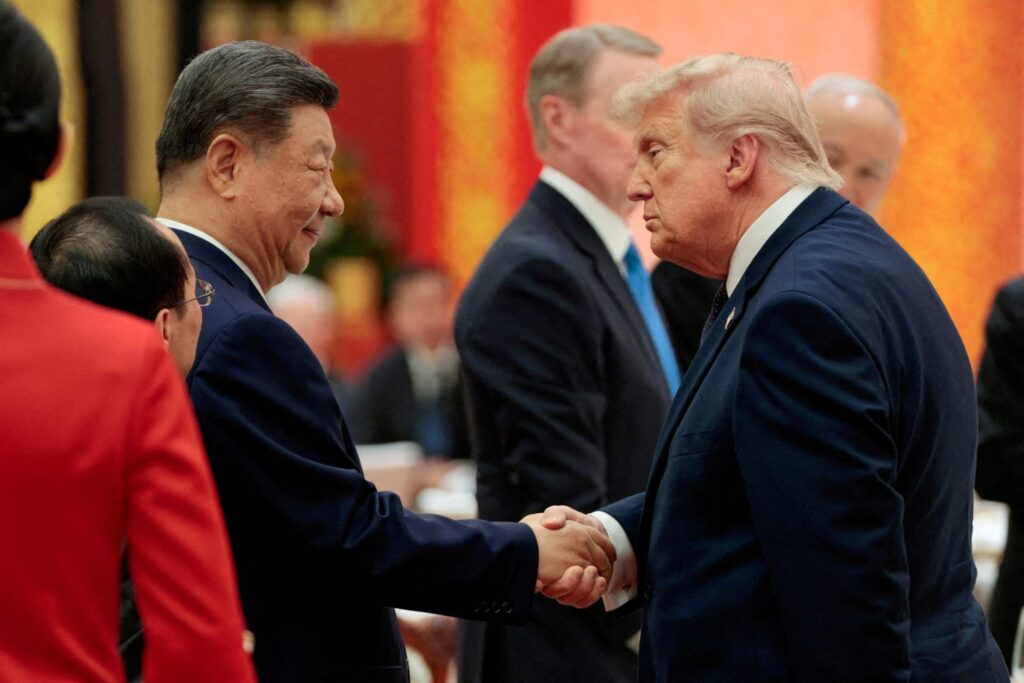
The meeting of Xi Jinping and Donald Trump in Beijing drew attention not only because of its political weight, but because it placed the technology industry at the center of global power talks. In the Great Hall of the People, the presence of leading corporate figures signaled that the contest between the United States and China now stretches far beyond tariffs and trade balances.
What stood out most was the way artificial intelligence, semiconductors, and smart-device ecosystems have become strategic assets. These are no longer just commercial sectors; they now help shape diplomacy, influence, and the future direction of international relations.
Technology has entered the diplomatic stage
Elon Musk of Tesla, Tim Cook of Apple, Jensen Huang of NVIDIA, and Jia Shaoqian of Hisense Group all added weight to the moment. Their presence showed that the most important arena in the rivalry between Washington and Beijing is increasingly the technology pipeline that powers modern economies.
NVIDIA continues to push global AI infrastructure, while Apple keeps expanding its smart-device ecosystem. At the same time, premium entertainment and advanced household appliances are growing as technology becomes more deeply embedded in daily life.
Hisense has been one of the clearest examples of a company moving aggressively in that direction. The company has introduced RGB-MiniLED visual technology and a heat pump-based energy-saving washing machine designed to be more environmentally friendly.
A global race built on scale and branding
Hisense’s international rise has been supported by a strong focus on independent innovation. Omdia data for 2025 placed the company first in the world for 100-inch-and-above TVs and Laser TV technology.
That position has also been reinforced through global sports branding. Hisense has officially become a Global Sponsor for the FIFA World Cup 2026™, a move that strengthens its brand recognition on the world stage.
For large corporations, sports and technology now serve a similar purpose. Both open access to global audiences while strengthening reputation in markets that are becoming more competitive.
The impact is already visible in Indonesia
The wider competition is not limited to geopolitics. In Indonesia, Hisense has shown strong momentum through its TV line, which has reached the number-one sales position in the Electronic City retail network.
Its business footprint in the country is also supported by a local factory in Purwakarta, West Java. The company further maintains a network of service centers across multiple cities, showing that its focus extends beyond sales to after-sales support.
A new step came through a Memorandum of Understanding with BPI Danantara in May 2026. The signing was witnessed directly by President RI Prabowo Subianto and Hisense Chairman Jia Shaoqian.
Room for research and technology transfer
The MoU opens the door to high-level technology transfer and the development of high-value research centers in Indonesia. If carried through as planned, the cooperation could strengthen local industrial capacity in electronics and related technology sectors.
Seen in a broader frame, the Beijing meeting between Xi Jinping and Donald Trump offers a clear picture of how technology has become a new language in international diplomacy. Indonesia is part of the ripple effect through investment flows, production expansion, and the growing possibility of research collaboration.